AI Citation Heatmap: A Practical Guide to Mapping Customer Questions
See which questions matter, which answer engines to target, and which pages to publish first, even without a website or development team.
Explore the no-code content workflow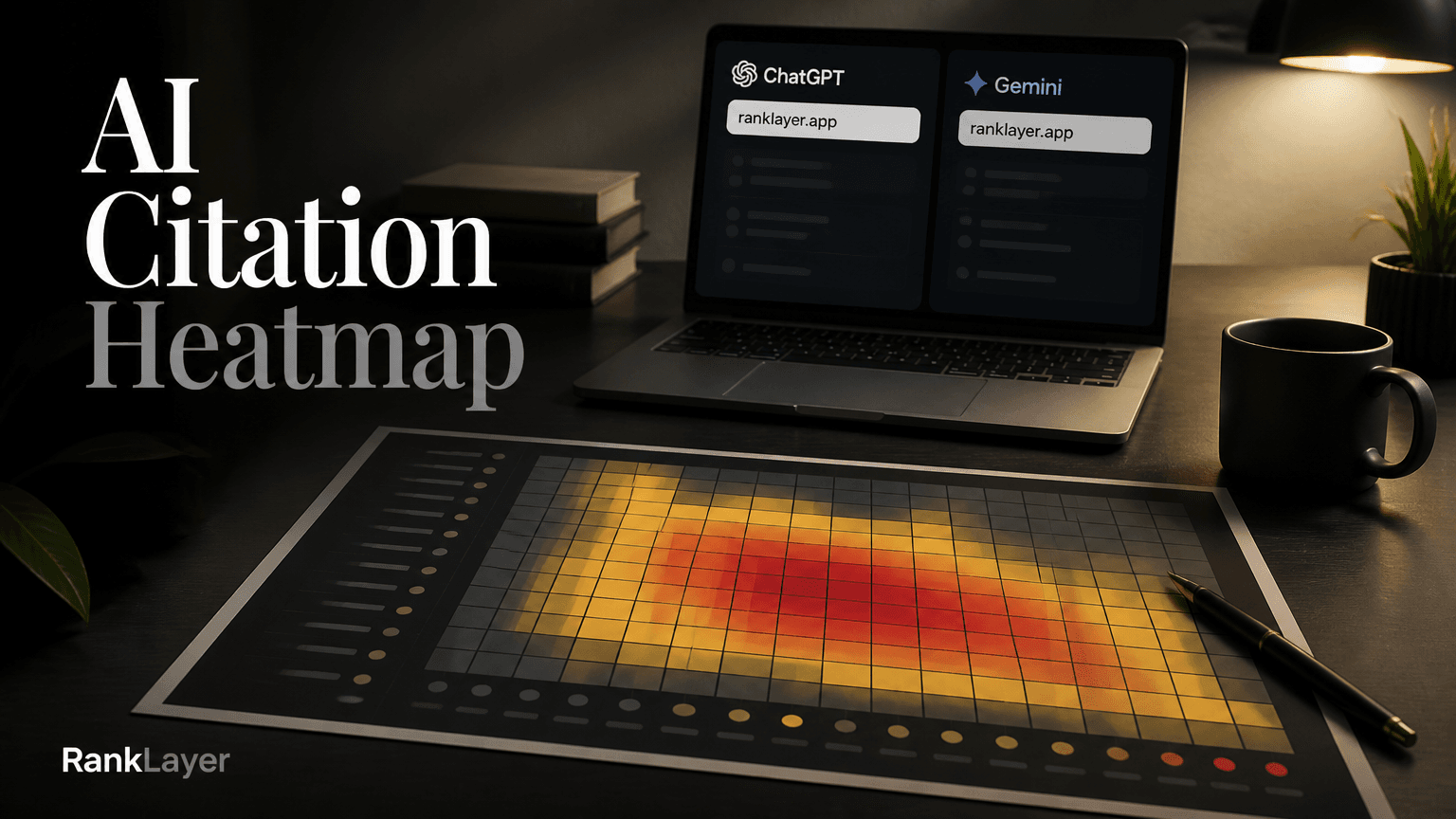
In this article8 sections
- What Is an AI Citation Heatmap?
- How to Build an AI Citation Heatmap from Customer Questions
- A Six-Step Workflow for Mapping Questions to AI Answer Engines
- Which Customer Questions Are Most Likely to Earn AI Citations?
- Match Each Question Cluster to the Right Page Format
- How to Prioritize AI Citation Topics When You Have No Website
- How RankLayer Fits the AI Citation Heatmap Workflow
- How to Measure the Heatmap Without Misreading AI Visibility
What Is an AI Citation Heatmap?
An AI citation heatmap is a visual way to connect your customers’ questions with the answer engines most likely to mention your business. Instead of treating every keyword as equally valuable, you plot each question by buyer intent, business relevance, opportunity, and observed visibility across ChatGPT, Gemini, and Perplexity.
Think of it as a weather map for your content. Red areas show questions with strong commercial potential but little useful coverage. Green areas show topics where your business already appears or where a well-built page has a realistic chance of being discovered and cited.
This approach matters because people no longer search only with short phrases such as “dentist Austin” or “email automation software.” They ask complete questions: “What is the best dentist for a nervous patient near Austin?” or “Which email automation tool is easiest for a small SaaS team?” Those questions reveal context, constraints, and buying intent in one sentence.
Google Search Console can show the queries that already bring impressions and clicks to your pages. Google Analytics can add behavioral context, such as which pages lead to contact form visits or booking events. You can verify how Search Console reports performance in the official Search Console performance documentation, then add answer-engine testing as a separate research layer.
The result is not a promise that an AI system will cite you. No ethical process can guarantee that. It is a repeatable prioritization system that helps a small business stop guessing and publish useful answers where demand and business value overlap.
How to Build an AI Citation Heatmap from Customer Questions
Start with a question inventory, not a keyword tool. Collect questions from sales calls, support tickets, Google Business Profile messages, product reviews, live chat, email, and your own memory of the questions customers ask before buying. A local accountant may quickly find questions about filing deadlines, pricing, business structures, and whether a consultation can happen remotely.
Next, add search data. Export queries from Google Search Console for the last 3 to 6 months, including impressions, clicks, click-through rate, and average position. Search Console data is imperfect, but it is grounded in real impressions for your property, which makes it more useful than a large list of disconnected keyword ideas.
If you use Google Analytics, connect questions to behavior. A query with 40 monthly impressions may be more valuable than one with 1,000 impressions if visitors from that topic request a quote at a much higher rate. GA4 lets you define and analyze events such as form submissions, purchases, phone clicks, and appointment requests. The Google Analytics event documentation explains how events are structured and measured.
Normalize the wording before scoring. “Best bookkeeping service for freelancers,” “bookkeeper for independent contractors,” and “do I need a bookkeeper as a freelancer?” may represent one topic cluster, but they are not the same page. Keep the customer language in your raw data, then group closely related questions under a clear intent label.
Finally, test representative prompts in ChatGPT, Gemini, and Perplexity. Record whether your business is mentioned, whether a competitor is cited, what sources appear, and what type of page those sources use. Test the same prompt more than once and record the date because responses can change with location, personalization, browsing, and model updates. Your heatmap should show observed patterns, not pretend to be a permanent ranking report.
For a useful starting worksheet, the customer question tagging workbook for AI citations provides a practical way to label questions by intent and page opportunity.
A Six-Step Workflow for Mapping Questions to AI Answer Engines
- 1
Gather at least 50 questions
Combine customer language from conversations with Search Console queries and site search terms. If you have fewer than 50, begin with 15 to 20 and expand weekly rather than filling the sheet with invented phrases.
- 2
Label the customer intent
Use labels such as learn, compare, choose, troubleshoot, locate, verify, and buy. A question like “how does teeth whitening work?” is educational, while “how much does teeth whitening cost near me?” is closer to a transaction.
- 3
Score business value
Rate each question from 1 to 5 for revenue potential, audience fit, and urgency. Add a confidence score if the topic is regulated, seasonal, or dependent on changing prices and availability.
- 4
Test the three platforms
Use consistent prompts and log results for ChatGPT, Gemini, and Perplexity. Capture mention status, linked sources, cited wording, location, date, and whether the answer appears to rely on a directory, editorial article, product page, or local listing.
- 5
Assign the best page format
Map questions to a format such as an FAQ article, service page, comparison page, local page, buying guide, or troubleshooting guide. One broad page should not be forced to answer every intent.
- 6
Publish, measure, and refresh
Publish the highest-priority pages, connect analytics events, and review results after 30, 60, and 90 days. Update facts, examples, pricing, and availability when the business changes instead of creating near-duplicate pages.
Which Customer Questions Are Most Likely to Earn AI Citations?
The strongest opportunities usually combine a clear question with a specific decision. “What is SEO?” is broad and competitive. “What is the best SEO option for a local restaurant with no website?” gives an answer engine a defined audience, use case, and constraint to match.
ChatGPT often needs clear context to produce a useful recommendation. Questions about fit, workflow, tradeoffs, and next steps can be valuable when your page explains who the solution is for, who should avoid it, what it costs, and how it compares with realistic alternatives. Make those answers easy to verify with plain language and specific evidence.
Gemini opportunities often connect to Google’s broader search ecosystem, especially queries with local, current, or practical context. A page that states service area, opening hours, appointment rules, product availability, and the date of the information gives the system more usable facts than vague promotional copy.
Perplexity is particularly useful for researching source patterns because its answers commonly expose linked references. Look for questions where the answer cites guides, documentation, product pages, and comparison content. If every cited source is an independent explanation, a thin sales page is unlikely to be enough on its own.
These are tendencies, not fixed rules. The same question may produce different sources on different days, and a platform may answer without citing any page. The practical lesson is to create pages that can stand alone as trustworthy resources, then observe which formats receive visibility over time.
For deeper intent analysis, compare this heatmap method with the keyword ROI scorecard for topics that convert and get cited. The heatmap adds platform behavior, while the scorecard helps prevent you from chasing attention that never becomes a customer.
Match Each Question Cluster to the Right Page Format
- ✓FAQ or question-led article: Use this for repeated educational questions, setup concerns, definitions, and objections. Put the direct answer near the top, then explain conditions, examples, and exceptions. This format works well when a customer needs confidence before contacting you.
- ✓Service or niche landing page: Choose this for a question that includes an audience, location, problem, or use case, such as “bookkeeping for freelance designers” or “same-day catering for office events.” Give the page one clear audience and one primary action.
- ✓Comparison or alternatives page: Use this when people are deciding between products, vendors, or approaches. Include neutral criteria, pricing context, limitations, and a clear explanation of where your offer fits. Avoid unsupported claims about competitors.
- ✓Buying guide: Create this for questions containing “best,” “how to choose,” “what should I look for,” or “is it worth it?” A useful guide defines evaluation criteria before mentioning your own solution, which makes the content more credible.
- ✓Local availability page: Use this for queries involving neighborhoods, service areas, delivery zones, opening times, or appointment availability. Include real operational details, not a list of city names pasted into a generic template.
- ✓Troubleshooting page: Choose this when customers are blocked by a specific problem. Step-by-step diagnosis, expected outcomes, and escalation options can attract highly qualified visitors because the reader already has an urgent need.
- ✓Product or category page: Use this when the question is close to purchase, such as “standing desk for a small home office” or “invoicing software with recurring billing.” Include specifications, use cases, exclusions, delivery or support details, and a concise answer to the buying question.
How to Prioritize AI Citation Topics When You Have No Website
A missing website does not mean you have no data. You can start with customer conversations, marketplace reviews, social comments, Google Business Profile questions, competitor FAQs, and the language people use when they contact you. The goal is not to build a giant content library immediately. It is to identify the first small set of questions that can produce useful pages.
Use a simple 100-point score: business value, 30 points; customer evidence, 20; specificity, 15; content gap, 15; citation fit, 10; freshness and maintenance effort, 10. A question scores higher when it is asked often, maps directly to an offer, has a clear audience, and can be answered accurately with information you control.
For example, a neighborhood bakery might score “where can I order a gluten-free birthday cake for Saturday?” at 88. It has urgent local intent and a clear conversion path. “What is sourdough?” may score 42 because it is educational, broad, and less connected to a specific purchase.
Publish the first five to ten pages as a small experiment. Include one question-led guide, two niche landing pages, one comparison or buying guide, and one practical FAQ page if those formats match your data. This mix gives you a way to compare discovery behavior instead of betting the entire strategy on one template.
A hosted publishing system can remove a major operational barrier for owners who do not have WordPress, a developer, or a full website. The zero-setup AI blog launch checklist covers the practical decisions around publishing consistently without turning your business into a part-time web development project.
How RankLayer Fits the AI Citation Heatmap Workflow
Once your question list is scored, RankLayer can serve as the publishing layer for the highest-priority opportunities. Its automatic AI blog includes hosting, so a small business can publish on a hosted subdomain without building WordPress or maintaining a separate technical stack.
A practical RankLayer-first workflow begins with connected Google Search Console and Google Analytics data. Use Search Console to identify impressions and query language, use Analytics to connect content visits with events, then turn the strongest clusters into ready-to-publish articles, FAQs, niche landing pages, or comparison pages.
The important detail is the handoff from data to page structure. A useful template should place the direct answer near the beginning, explain the audience and use case, include verifiable business details, address limitations, and provide a natural next step. Add appropriate structured data where it accurately describes visible page content, but do not treat schema as a substitute for substance.
For example, a small SaaS company might discover 18 queries about automating reports for agencies. Instead of publishing one generic “automation software” article, it could create a guide for agency reporting, a comparison page for spreadsheet versus automated reporting, and a troubleshooting FAQ about client-ready exports.
RankLayer can then publish these pages on a schedule, while the owner reviews facts, examples, and claims. Automation is useful because consistency is difficult for a busy operator, but human review still matters for pricing, medical or legal information, guarantees, local availability, and competitor comparisons.
The AI citation signals checklist for no-code programmatic SEO is a useful companion for reviewing whether each page is understandable, crawlable, specific, and genuinely helpful before you publish it.
How to Measure the Heatmap Without Misreading AI Visibility
Track four layers separately: search demand, organic performance, AI visibility, and business outcomes. Search Console can show impressions, clicks, and average position. Analytics can show engagement and conversion events. Your prompt log can show whether a platform mentioned your business and which URL it cited. Your CRM, booking system, or form records can show whether that attention became revenue.
Create a monthly table with one row per question cluster. Useful columns include query family, page URL, primary intent, target platform, mention status, cited URL, organic impressions, organic clicks, assisted conversions, and last factual review. A citation without traffic is still a visibility signal, but it should not be reported as a sale.
Avoid testing only branded prompts. “What does RankLayer do?” tells you about brand recognition, not discovery. Test non-branded prompts such as “how can a small business publish SEO content without a website?” and then record whether the answer includes your category, competitors, or business.
Do not overreact to a single response. Run three to five consistent tests across different dates, keep the location and wording stable, and report a range rather than a dramatic win or loss. AI responses are probabilistic, and platform interfaces can change.
Common mistakes include publishing hundreds of nearly identical pages, hiding the useful answer behind a form, making unsupported “best” claims, copying competitor language, and ignoring stale details. Thin pages may create maintenance work without building trust, while a small set of specific, accurate pages can create a much stronger foundation.
A good heatmap is therefore a decision tool, not a vanity dashboard. Every red square should lead to a clear action: publish, improve, consolidate, verify, or leave it alone for now.
Frequently Asked Questions
What is an AI citation heatmap?▼
An AI citation heatmap is a visual framework for mapping customer questions against business value, search demand, page opportunities, and observed visibility in ChatGPT, Gemini, and Perplexity. It helps you see which topics deserve attention first. The heatmap does not guarantee citations, because answer-engine results can change, but it creates a consistent way to prioritize content and measure progress.
What types of customer questions are most likely to be cited by ChatGPT, Gemini, or Perplexity?▼
Questions with a clear audience, use case, location, constraint, or buying decision are often more actionable than broad informational topics. Examples include “which accounting software is best for freelancers,” “where can I find same-day catering near me,” and “how do I choose a dentist for a nervous patient?” A page still needs accurate information, clear structure, and credible supporting details before it can become a useful source.
Can I build an AI citation heatmap without a website?▼
Yes. Begin with customer conversations, marketplace reviews, social questions, Google Business Profile messages, and any available Search Console or Analytics data. You can publish useful pages on a hosted subdomain, provided the content is accessible, specific, and connected to a real business. A website can help with branding and conversion, but it is not the only way to begin building searchable content.
How do I use Google Search Console for an AI citation heatmap?▼
Export queries and pages from the Performance report, ideally covering the last three to six months. Group similar queries into intent clusters, then record impressions, clicks, click-through rate, and average position for each cluster. Search Console does not directly report ChatGPT, Gemini, or Perplexity citations, so combine its data with manual prompt tests and analytics conversion data.
Which page format is best for AI citations, an FAQ, landing page, or comparison page?▼
The best format depends on the question rather than the platform alone. FAQs suit repeated educational and objection-based questions, landing pages suit a specific audience or use case, and comparison pages suit evaluation intent. Choose the format that gives the reader the most complete and honest answer, then test similar formats against your own visibility and conversion data.
How often should I test whether ChatGPT, Gemini, and Perplexity cite my business?▼
Monthly testing is a sensible starting point for most small businesses, with additional checks after publishing an important page or changing major business information. Use a consistent prompt set and record the date, location, platform, cited URLs, and answer wording. Testing three to five times per prompt is more informative than treating one response as a permanent result.
Does structured data guarantee that an AI answer engine will cite my page?▼
No. Structured data helps search systems interpret eligible information when it accurately matches visible page content, but it does not force a citation or ranking. Helpful writing, crawlable pages, clear business details, and consistent information across the web remain essential. Use schema as supporting infrastructure, not as a shortcut around quality.
How can a small business prioritize AI citation topics with limited time?▼
Score questions by revenue potential, customer evidence, specificity, content gap, citation fit, and maintenance effort. Start with five to ten pages that answer urgent, commercially relevant questions instead of trying to publish hundreds of generic articles. Review performance after 30, 60, and 90 days, then expand the clusters that attract qualified visitors or meaningful customer conversations.
Turn your customer questions into a practical publishing plan
Explore RankLayerAbout the Author
Vitor Darela de Oliveira is a software engineer and entrepreneur from Brazil with a strong background in system integration, middleware, and API management. With experience at companies like Farfetch, Xpand IT, WSO2, and Doctoralia (DocPlanner Group), he has worked across the full stack of enterprise software - from identity management and SOA architecture to engineering leadership. Vitor is the creator of RankLayer, a programmatic SEO platform that helps SaaS companies and micro-SaaS founders get discovered on Google and AI search engines