What Is an AI Citation Schema? A Simple Guide for Small Businesses to Get Quoted by ChatGPT, Gemini, and Perplexity
Learn the practical combination of structured data, clear evidence, and discoverable content that can help ChatGPT, Gemini, and Perplexity find and quote your pages.
Explore the practical framework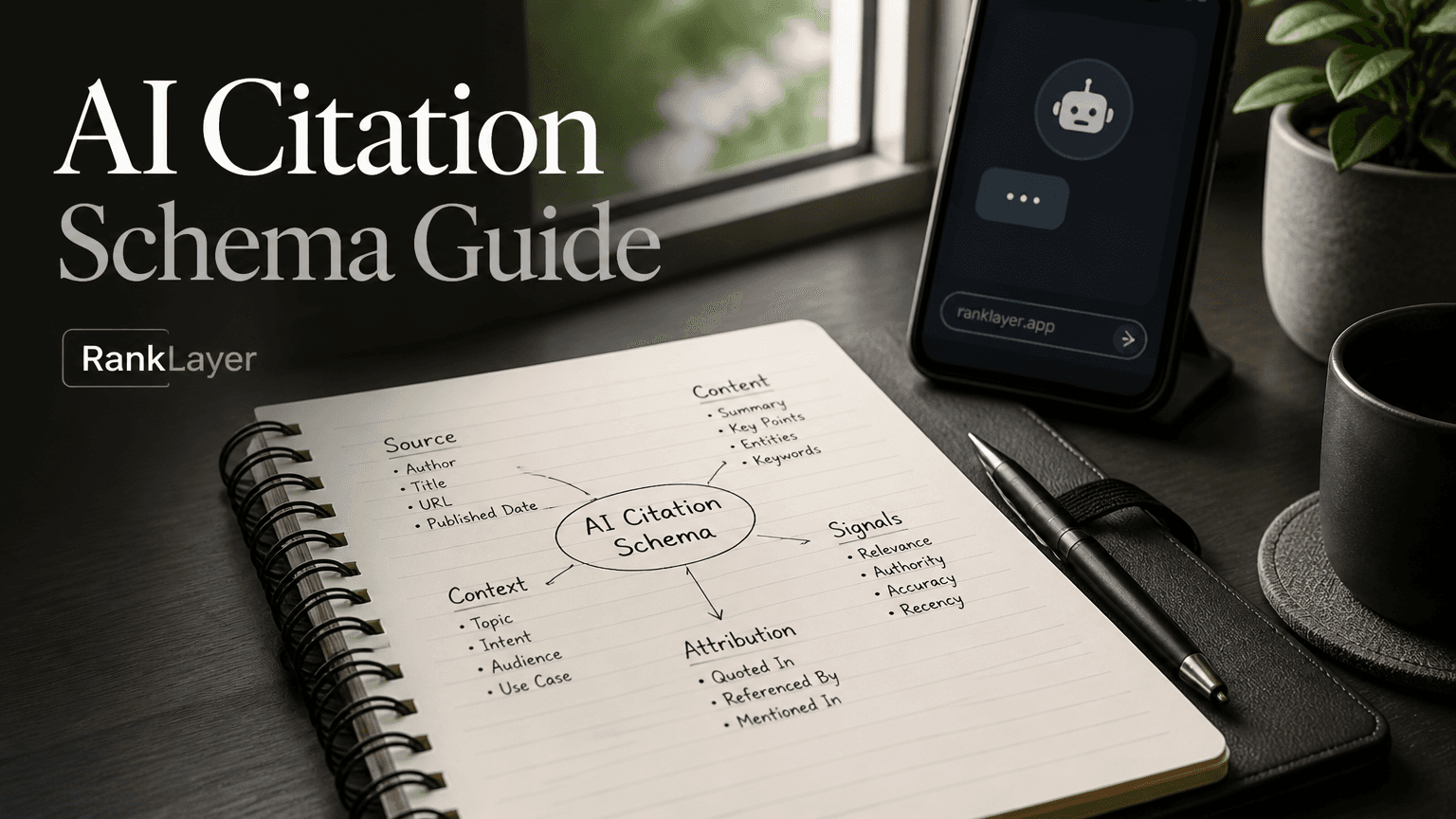
In this article9 sections
- What is an AI citation schema?
- How ChatGPT, Gemini, and Perplexity decide what to quote
- The six layers of an effective AI citation schema
- How to structure a page so AI systems can find and cite it
- Which schema types and metadata should a small business use?
- How RankLayer applies an AI citation schema automatically
- How to measure whether AI answer engines are citing your pages
- Common mistakes and a practical 30-day implementation plan
- The principles that make an AI citation schema trustworthy
What is an AI citation schema?
An AI citation schema is a practical framework for organizing a web page so search engines and AI answer engines can understand its subject, facts, relationships, and source context. It is not an official markup standard created by OpenAI, Google, Anthropic, or Perplexity. Think of it as a repeatable combination of structured data, readable page architecture, and concise evidence blocks that makes your content easier to retrieve and evaluate.
A small business page usually contains useful information, but that information may be scattered across a menu, social profile, image, contact page, and outdated directory listing. An AI system answering a customer question has to connect those pieces before it can confidently mention the business. A well-organized page reduces that detective work.
The word schema can be confusing because it often refers to Schema.org vocabulary and JSON-LD markup. Those are important parts of the framework, but they are not a magic switch for AI citations. Schema.org’s official documentation explains how structured data describes entities such as businesses, products, events, and articles.
The goal is not to trick an answer engine into quoting you. The goal is to publish a page that clearly answers a real question, identifies who is responsible for the information, states important facts in plain language, and supports those facts with consistent signals across the web.
For example, a dentist might publish a page answering, “Does a dentist in Austin accept emergency appointments on Saturdays?” A citation-ready page would state the service, location, hours, booking method, last update, and limitations in visible text. Its structured data would reinforce the page type and business identity, rather than trying to hide information in code.
How ChatGPT, Gemini, and Perplexity decide what to quote
AI answer engines do not select sources from one universal ranking formula. Their systems can use search indexes, retrieval layers, knowledge graphs, model training data, user context, and freshness signals. The exact weighting changes by platform and query, so no honest strategy can guarantee that a specific page will be cited.
Still, the same practical patterns appear again and again. A page is easier to use when its topic is unambiguous, its claims are specific, its business identity is consistent, and the answer to the likely question appears near the relevant heading.
Retrieval also favors pages that can be matched to a precise need. “We provide quality solutions” tells an AI almost nothing. “Our Portland bookkeeping firm serves restaurants with monthly bookkeeping, payroll reconciliation, and quarterly tax-ready reports” gives the system several useful entities and relationships.
Freshness matters when the question involves availability, price, opening hours, inventory, or current policy. A page that says “updated October 2026” and reflects the same information found in your Google Business Profile and booking system is easier to trust than a page with conflicting dates from three years ago.
Consistency is especially important for small businesses without a large backlink profile. Your business name, address, phone number, service area, product descriptions, and brand spelling should not change from page to page. Conflicting information creates uncertainty, and uncertainty makes a cautious answer engine less likely to recommend you.
You can use Google’s structured data guidelines as a technical reference, but remember their central lesson: markup should describe visible, useful content. Adding FAQ or LocalBusiness code to a thin page will not turn weak information into a trustworthy source.
For a broader content workflow, start with real customer language. The guide to conversational keyword patterns for local businesses shows why queries such as “who delivers near me tonight?” often reveal more useful page opportunities than short keywords such as “delivery.”
The six layers of an effective AI citation schema
- ✓Entity identity: State the exact business name, brand, location, website, contact details, and business category. Connect related profiles with consistent naming and, where appropriate, sameAs references.
- ✓Answer intent: Match each page to one clear customer question or decision. A page about emergency dental care should not also try to rank for every cosmetic dentistry service in the same city.
- ✓Evidence blocks: Add short, direct statements that can stand alone when quoted. For example: “Greenline Dental offers same-day emergency appointments in North Austin, subject to availability.”
- ✓Structured data: Use relevant Schema.org types such as Organization, LocalBusiness, Product, Service, Article, FAQPage, or Event when the visible page content supports them. Choose the type that accurately describes the page instead of adding every available type.
- ✓Relationship links: Link the page to related services, locations, products, authors, policies, and contact routes. These connections help both people and machines understand how the page fits into the wider business.
- ✓Freshness and accountability: Display an author or business owner where appropriate, include a publication or update date, and review claims that can change. A simple review schedule is more valuable than publishing hundreds of forgotten pages.
How to structure a page so AI systems can find and cite it
- 1
Choose one customer question
Start with a question your customer might ask ChatGPT, Gemini, or Perplexity. Examples include “Which accountant helps freelancers file quarterly taxes in Denver?” or “What is the best running shoe for flat feet under $150?” One focused question creates a clearer page purpose.
- 2
Write the direct answer near the top
Answer the question in one or two sentences before adding background. Include the business, product, service, location, or qualification that matters. Do not make readers or retrieval systems dig through six paragraphs to find the point.
- 3
Add supporting facts in labeled blocks
Use headings such as Services, Who It Is For, Pricing, Availability, Areas Served, and How to Book. Short sections, lists, and tables make details easier to scan, compare, and quote.
- 4
Add proof and boundaries
Explain what supports the claim, such as a license, delivery area, warranty, customer outcome, or published policy. Also state limitations, including appointment availability, minimum order values, or service exclusions.
- 5
Apply only matching metadata
Add JSON-LD that describes the visible page. Include the canonical URL, business identity, relevant offers, author, dates, and relationships when they are accurate. Validate the markup and fix warnings that could create confusion.
- 6
Connect the page to your content network
Link to your main service page, related question pages, location pages, and contact or booking route. A new page should not sit alone like an island that nobody can reach.
- 7
Submit, observe, and improve
Use Google Search Console to check indexing, queries, impressions, and clicks. Test representative prompts in AI answer engines manually, record whether your business appears, and update the page when facts or customer language change.
Which schema types and metadata should a small business use?
There is no single “AI citation schema” type that you can paste into a page. Instead, select structured data according to the page’s actual purpose. A local clinic may use a suitable LocalBusiness subtype on its business page, while a product page may use Product and Offer information. An educational article may use Article, author, and date properties.
FAQPage markup deserves careful handling. It can help machines understand a genuine question-and-answer section, but the questions and answers should be visible to readers and should reflect content you are willing to stand behind. Markup should not be used to create invisible keyword lists or pretend that a page contains answers it does not show.
Metadata outside JSON-LD also matters. Use a descriptive title, a useful meta description, one clear canonical URL, descriptive image alt text, and an accessible heading structure. These elements help search engines process the page and help visitors decide whether the page is relevant.
A practical evidence block might look like this: “BrightPath Accounting serves self-employed professionals in Phoenix with monthly bookkeeping and quarterly tax preparation.” The next sentence can clarify who qualifies, what is included, and how the information was verified.
Avoid stuffing every page with the same business description. Repetition without added value can create a large collection of pages that look interchangeable. Give each page a distinct customer question, useful local or product detail, and a reason to exist.
For a page-level technical checklist, this guide to no-code structured data for hosted AI blogs explains how to handle JSON-LD, visible copy, validation, and publishing without asking a developer to edit templates.
How RankLayer applies an AI citation schema automatically
Once the fundamentals are clear, automation can remove the tedious part. RankLayer uses a compact AI citation schema approach that combines structured-data generation, one-sentence evidence blocks, and GEO-focused microcopy inside automatically published pages. The point is not to promise a citation, but to make each page more understandable, indexable, and useful to a person or answer engine.
A typical workflow starts with a customer question or topic. The system can turn that topic into a complete article, add relevant metadata, publish it on hosted infrastructure, and create a consistent path for search crawlers to discover it. This is useful for a shop owner, freelancer, clinic, course creator, or SaaS founder who has expertise but no spare afternoon for technical publishing.
The Google Search Console integration adds an important feedback loop. After pages are published, query and indexing data can reveal which questions are receiving impressions, which pages need stronger answers, and where new content opportunities are emerging. Search Console does not provide a direct ChatGPT citation report, but it helps confirm that Google can discover and index the content that AI systems may later retrieve.
Daily publishing can also support freshness, provided quality controls remain in place. Ten genuinely useful pages with accurate facts are better than 1,000 thin pages that repeat the same paragraph with a different city name. Review regulated claims, prices, schedules, health information, and legal statements before allowing them to run unattended.
For owners who do not have a website, a hosted blog can provide a practical starting point. You still need accurate business information, a clear conversion path, and a way to monitor performance, but you do not need to install WordPress or build a publishing stack from scratch. The zero-setup AI blog launch checklist provides a useful companion workflow for getting the basics in place.
How to measure whether AI answer engines are citing your pages
Measurement is harder than traditional SEO because ChatGPT, Gemini, and Perplexity do not provide one shared analytics dashboard. A citation can also vary by location, account, prompt wording, browsing mode, model version, and time. Treat your results as an experiment rather than a permanent ranking position.
Create a prompt set of 20 to 30 realistic questions. Include branded queries, non-branded service questions, local questions, comparison questions, and urgent or seasonal searches. Run the same prompts on a consistent schedule, recording the date, platform, exact wording, cited URLs, whether your business was mentioned, and whether the answer was accurate.
Track four simple metrics: citation rate, source-page rate, accuracy rate, and action rate. Citation rate is the percentage of tests that mention your business or page. Source-page rate shows whether the answer engine cites the page you intended, accuracy rate catches incorrect hours or services, and action rate measures visits, calls, bookings, signups, or other meaningful outcomes.
Google Search Console adds supporting evidence. Watch impressions, clicks, queries, indexed pages, and average position for the pages behind your citation tests. Analytics can then show whether visitors from those pages engaged with a booking form, product page, phone link, or checkout path.
Keep a change log when you update headings, evidence blocks, schema, internal links, or business facts. If citation frequency improves after a specific change, you have a useful local signal. It is not a universal algorithm rule, but it is much more informative than guessing.
For attribution, this guide to tracking AI answer engine citations and organic leads covers prompt monitoring, analytics events, lead attribution, and the limits of available platform data.
Common mistakes and a practical 30-day implementation plan
- 1
Days 1 to 3: Clean up your business identity
Write down your official business name, address, phone number, service area, hours, primary category, website, and booking route. Compare these details across your main pages, Google Business Profile, directories, and social profiles.
- 2
Days 4 to 7: Collect real customer questions
Review emails, chat messages, sales calls, reviews, and support tickets. Group questions by service, location, price, timing, suitability, and comparison intent. Real questions are usually more valuable than a giant list of disconnected keywords.
- 3
Week 2: Publish three focused pages
Create one page for a core service, one page for a high-intent customer problem, and one page for a local or audience-specific variation. Give each page a direct answer, evidence block, supporting details, internal links, and a clear next step.
- 4
Week 3: Add and validate structured data
Choose the Schema.org types that match each page and add JSON-LD without contradicting visible copy. Test the markup, inspect the canonical URLs, confirm pages are crawlable, and connect Google Search Console and Analytics.
- 5
Week 4: Run citation tests
Ask ChatGPT, Gemini, and Perplexity the same 20 to 30 questions before and after publishing. Record citations and errors, then improve the pages that answer important questions but are not yet being discovered.
The principles that make an AI citation schema trustworthy
- ✓Use schema to clarify real content, never to disguise thin or unsupported claims.
- ✓Put the answer in visible text before adding technical markup.
- ✓Give each page one main job, such as explaining a service, answering a local question, or helping someone compare options.
- ✓Prefer specific facts over broad adjectives. “Open until 8 p.m. on Thursdays” is more useful than “convenient evening hours.”
- ✓Keep facts synchronized across your website, hosted blog, business listings, and booking systems.
- ✓Refresh information that changes quickly, including prices, inventory, menus, hours, eligibility, and appointment availability.
- ✓Measure citations alongside leads and customer actions. Being quoted is useful only when the information is accurate and helps someone take the next step.
- ✓Automate repetitive publishing tasks, but keep human review for claims where a mistake could damage trust, safety, compliance, or revenue.
Frequently Asked Questions
Is AI citation schema an official schema type?▼
No. AI citation schema is a practical term for combining structured data, clear page structure, evidence statements, and discoverability practices. Schema.org provides the vocabulary for describing entities such as businesses, products, services, and articles, but it does not provide a special markup type that guarantees citations from ChatGPT, Gemini, or Perplexity. Use the term as a workflow framework, not as a claim of official platform certification.
Does adding JSON-LD guarantee that ChatGPT will cite my business?▼
No. JSON-LD can help search systems interpret page content, but it cannot force an answer engine to retrieve or cite a page. Citation decisions can depend on relevance, source quality, freshness, crawlability, user context, and platform-specific retrieval behavior. The strongest approach combines accurate visible content, useful answers, consistent business information, technical accessibility, and ongoing testing.
Which schema types are best for getting cited by AI answer engines?▼
The best type depends on the page. LocalBusiness or an appropriate subtype may fit a local business page, Product and Offer may fit a product page, Service may fit a service description, and Article may fit an informational post. FAQPage can describe a visible question-and-answer section when it is genuinely present. Accuracy matters more than choosing the most elaborate schema combination.
How should I write an AI-citable evidence block?▼
Write one factual sentence that can stand on its own without surrounding context. Include the subject, service or product, audience or location, and a meaningful qualification when needed. For example, “Northside CPA serves freelance designers in Chicago with monthly bookkeeping and quarterly tax preparation.” Follow it with supporting details, proof, limitations, and a route to contact or book.
Can a small business get cited by ChatGPT without a website?▼
It is possible to build discoverable content without owning a traditional website, but you still need public, crawlable pages and consistent business information. Hosted blogs, business profiles, directories, marketplace pages, and public social content can all contribute to your online presence. A hosted publishing platform can simplify the technical side, but it does not remove the need for accurate facts, useful content, and a clear customer action.
How do I know whether Gemini or Perplexity is using my content?▼
Run a repeatable prompt test and record the exact answer, citations, cited URLs, date, location, and platform settings. Test branded and non-branded questions, because a system may cite you for a specific service while ignoring you for a broad category query. Combine these observations with Google Search Console, Analytics, call tracking, booking data, and lead records to understand whether visibility is producing business results.
How often should I update pages designed for AI citations?▼
Update a page whenever a core fact changes, such as price, hours, inventory, service coverage, policy, or availability. For evergreen educational pages, review them at least quarterly or whenever Search Console and customer questions reveal new information. Publishing daily can help a business cover more questions, but freshness should never mean changing dates without improving the content.
Make your next helpful answer easier to discover
Learn how RankLayer can helpAbout the Author
Vitor Darela de Oliveira is a software engineer and entrepreneur from Brazil with a strong background in system integration, middleware, and API management. With experience at companies like Farfetch, Xpand IT, WSO2, and Doctoralia (DocPlanner Group), he has worked across the full stack of enterprise software - from identity management and SOA architecture to engineering leadership. Vitor is the creator of RankLayer, a programmatic SEO platform that helps SaaS companies and micro-SaaS founders get discovered on Google and AI search engines