How to Discover the Alternatives Questions ChatGPT and Gemini Use
A beginner-friendly method for uncovering alternatives searches, understanding AI answer patterns, and creating helpful content without a large SEO team.
Explore RankLayer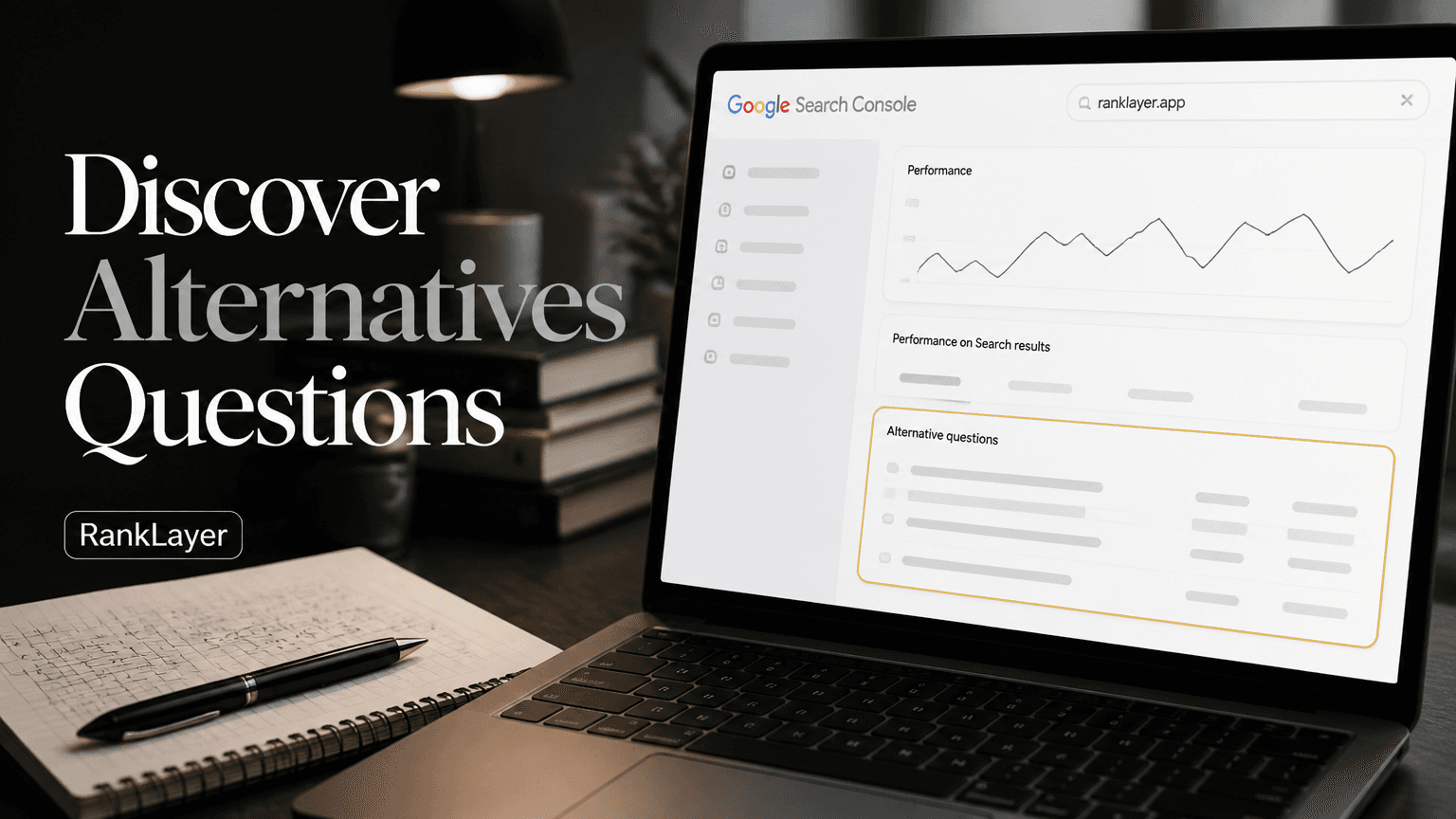
In this article8 sections
- What are alternatives questions, and why do they matter?
- How ChatGPT and Gemini interpret alternatives queries
- How to discover alternatives questions with free tools
- How to read Google Search Console alternatives signals
- How to phrase an alternatives page so AI can cite it
- Common mistakes when publishing alternatives content
- How to turn alternatives questions into a simple publishing workflow
- Where RankLayer fits for a small business without an SEO team
What are alternatives questions, and why do they matter?
Alternatives questions ChatGPT and Gemini use often begin with a simple concern: “What else should I consider?” A shopper may ask for an alternative to a product, a founder may look for software that replaces a competitor, and a local customer may want another service that fits a budget, location, or schedule.
These searches are valuable because the person already understands the category. They are not starting with “What is accounting software?” They are closer to a decision, such as “What is a simpler alternative to QuickBooks for a freelancer?” or “What are the best alternatives to a large wedding venue in Austin?”
Google may show these searches as traditional results, while ChatGPT and Gemini may turn them into a conversational answer with several recommendations. That answer can mention businesses and products that clearly explain who they serve, what they offer, and when they are a sensible alternative.
An alternatives page is not a license to insult a competitor or copy its branding. It is a useful decision guide that explains the differences between options. The strongest pages help readers choose, even when the best choice is not the business that published the page.
For a broader introduction to this content format, see what alternatives pages are and how they capture comparison intent. The important idea is simple: alternatives content connects an existing customer need with a specific reason to switch.
How ChatGPT and Gemini interpret alternatives queries
AI answer engines do not treat every “alternative” phrase as the same request. They look at the words around the competitor or category to infer the reason behind the search. “Alternative to X for small teams” signals a different need from “cheaper alternative to X” or “alternative to X with no monthly subscription.”
That surrounding language is called the query context. It can include company size, industry, location, price sensitivity, integrations, technical skill, urgency, or a desired outcome. A small dental clinic might ask for an alternative scheduling tool that supports reminders, while a solo consultant may care more about a low-cost setup and easy invoicing.
ChatGPT and Gemini also need clear facts to produce a dependable answer. Pages are easier to summarize when they state the answer directly, use descriptive headings, separate facts from opinions, and show how information was collected. A vague paragraph saying “we are the best” gives an answer engine very little useful material.
A practical page should contain a short answer near the top, followed by evidence. For example: “For independent photographers who need online booking without complex setup, BrightBook is an alternative to enterprise scheduling platforms because it offers fixed pricing, payment links, and simple calendar management.”
This does not guarantee a citation. No publisher can promise that ChatGPT or Gemini will recommend a page. It does give the systems a clean, verifiable passage to understand and potentially use. Google’s Search Central guidance on creating helpful, reliable, people-first content is a useful foundation because content made for real decision-makers tends to be clearer for machines too.
How to discover alternatives questions with free tools
- 1
Start with competitor and category seeds
Write down five to ten names customers already mention, plus the category terms they use. Add phrases such as “alternative to,” “similar to,” “replacement for,” “better than,” “cheaper than,” and “for small businesses.” For a local business, include location and service combinations, such as “alternative to downtown catering for a corporate lunch.”
- 2
Filter Google Search Console queries
In Search Console, open Performance, then Search results, and filter queries containing “alternative,” “similar,” “replacement,” “instead,” “competitor,” or “vs.” Review impressions even when clicks are low. A query with 40 impressions and an average position near 8 can be a better first page opportunity than a broad term with thousands of impressions and no buying context.
- 3
Group variations by the reason for switching
Put queries into practical buckets: lower price, easier setup, better support, specific integration, local availability, industry fit, or a missing feature. “Alternative to X for agencies” and “alternative to X with white labeling” may deserve separate pages because the decision criteria are different.
- 4
Use Google autocomplete and related questions
Search the competitor name with a partial phrase and inspect autocomplete suggestions. Then review People Also Ask results and related searches. These features do not reveal private chatbot prompts, but they expose natural language that people already use, which is a strong source of question wording.
- 5
Ask ChatGPT and Gemini for question expansion
Use both tools as brainstorming assistants, not as proof of search volume. Try: “List the questions a small business owner might ask when looking for an alternative to [competitor]. Group them by price, features, setup, support, and industry.” Save recurring questions, then validate them against Search Console, customer conversations, reviews, and sales notes.
- 6
Check customer language in real places
Read support emails, contact forms, reviews, onboarding calls, and community discussions. Phrases like “I need something less complicated” or “Can this replace X without migrating everything?” often become stronger content angles than polished keyword-tool suggestions.
- 7
Score each question before publishing
Give each query a score from 1 to 5 for customer intent, relevance, evidence available, distinctiveness, and business value. A question scoring 20 or more out of 25 is a sensible candidate for a dedicated page or a section in a broader guide.
How to read Google Search Console alternatives signals
Search Console is especially useful because it shows the language people used to reach your pages, not just the keywords you hoped they would use. Select a 3-month range first, then compare it with the previous period. Look for new alternative phrases, rising impressions, and queries where your site is visible but receives few clicks.
Impressions reveal demand, but they do not automatically prove commercial value. A query such as “alternatives to free photo editors” may be research-oriented, while “best alternative to [tool] for real estate agents” signals a more specific business problem. Add the audience, constraint, or desired outcome to distinguish the two.
Use a spreadsheet with these columns: exact query, impressions, clicks, click-through rate, average position, likely intent, switching reason, page URL, evidence available, and next action. This turns a messy report into a content pipeline. It also makes it easier to notice when five similar queries should become one useful page instead of five thin pages.
Here is a practical example. Suppose a bookkeeping service sees impressions for “QuickBooks alternative for small business,” “simple bookkeeping instead of QuickBooks,” and “bookkeeping software for non-accountants.” Those phrases may belong in one guide if the same reader and decision are involved, with separate sections for ease of use, pricing, and service support.
Search Console data has limits. It does not show every question asked in ChatGPT or Gemini, and it cannot tell you exactly why an answer engine selected a source. Still, it provides a grounded starting point that is more reliable than guessing what “the AI” might want. Google explains how to analyze Search performance reports so you can interpret impressions and clicks correctly.
How to phrase an alternatives page so AI can cite it
Begin with a direct answer that names the audience and the switching reason. A useful opening formula is: “[Your business] is an alternative to [competitor] for [audience] who need [specific outcome]. It is a strong fit when [condition], but [important limitation] should be considered.”
This structure works because it is honest and specific. It gives a reader an immediate answer while giving an answer engine a compact summary that can be understood without reading the entire page. Keep the opening to roughly 40 to 70 words, then support it with details below.
Next, create sections around decisions rather than generic features. Good headings include “Best for small teams,” “Where it is simpler,” “What migration involves,” “Pricing considerations,” “Important limitations,” and “How it compares with the usual alternative.” A feature dump may be accurate, but a decision guide is much easier to use.
Use short fact blocks for information that should not be buried. For example:
“Best fit: independent consultants who need appointment booking and payment links.”
“Main difference: the service includes setup assistance, while many competing tools require self-guided configuration.”
“Before choosing: confirm that the current calendar and payment provider are supported.”
Avoid claims you cannot verify, especially statements about a competitor’s pricing, customer count, security, or product roadmap. Use a date for changing facts, link to primary documentation where possible, and say “based on the information reviewed on October 19, 2026” when a snapshot matters.
For more ready-to-use structures, review these headline and lead-sentence formulas for AI answer engines. The goal is not to trick a chatbot into quoting you. The goal is to make your page the clearest answer available for a real question.
Common mistakes when publishing alternatives content
- ✓Creating pages for every minor keyword variation: If “alternative to X” and “replacement for X” serve the same audience and decision, combine them into one stronger resource. Do not produce dozens of near-identical pages with swapped nouns.
- ✓Using unsupported competitor claims: Never guess at pricing, feature gaps, legal status, performance, or customer complaints. Verify important facts, cite primary sources, and label your own testing or opinion clearly.
- ✓Making the page a disguised sales pitch: Readers notice when every comparison ends with the same exaggerated conclusion. Explain who should choose your offer, who should not, and what tradeoffs deserve attention.
- ✓Copying competitor language or visual identity: Use a competitor’s name only when necessary to identify the comparison. Avoid logos, screenshots, or wording that could imply endorsement or affiliation.
- ✓Ignoring regulated industries: Lawyers, clinics, accountants, and financial professionals should avoid turning an alternatives page into personalized advice or unsupported promises. Add appropriate disclaimers and arrange human review for sensitive claims.
- ✓Forgetting freshness: Prices, integrations, availability, and product features change. Set a review date and revisit pages when Search Console shows a traffic drop or customers report outdated information.
- ✓Hiding the useful answer behind a form: Public, readable comparison information can be discovered and summarized. If you need lead qualification, place the form after the core answer instead of blocking the entire page.
- ✓Treating AI citations as guaranteed traffic: A citation may create awareness, but it does not guarantee a click or sale. Track branded searches, referral visits, inquiries, and assisted conversions together.
How to turn alternatives questions into a simple publishing workflow
- 1
Create a question bank
Export relevant Search Console queries once a month and add questions from customer conversations. Tag each one by competitor, audience, switching reason, location, and buying stage. Start with 10 to 20 questions rather than trying to cover the entire market on day one.
- 2
Choose the right page format
Use a full alternatives guide when several switching reasons belong to one audience. Use a focused page when the query includes a distinct need, such as a local service, an industry, or a specific integration. A page should answer one main decision clearly.
- 3
Build an evidence brief
Collect your own pricing, service details, delivery areas, customer outcomes, policies, and support terms. Add links to competitor documentation only where a comparison depends on a changing fact. This brief reduces hallucinations and makes human review much faster.
- 4
Publish the answer in a consistent structure
Use a direct summary, audience fit, comparison criteria, tradeoffs, frequently asked questions, and a next step. Add a visible update date when facts can change. Keep the tone helpful, especially when discussing a competitor.
- 5
Measure both search and business outcomes
Track impressions, clicks, average position, assisted conversions, calls, bookings, and form submissions. Test the page for branded searches in ChatGPT and Gemini periodically, but treat those checks as directional because answers can vary by location, account, model, and browsing context.
- 6
Refresh or consolidate
After 60 to 90 days, compare the page with the actual queries it earns. Expand sections that attract impressions, rewrite weak introductions, and merge pages with overlapping intent. Quality control matters more than publishing a huge number of thin alternatives pages.
Where RankLayer fits for a small business without an SEO team
Once you have validated the questions, the difficult part is often consistency. A local shop owner, freelancer, or SaaS founder may know exactly what customers ask but still lack the time to research, write, format, host, and publish a useful article every week.
RankLayer provides a hosted automatic AI blog that can publish SEO-focused articles without WordPress or a separate website. With Google Search Console connected, you can use real query signals as input for a daily content workflow, including alternatives topics, comparison questions, and customer FAQs.
A sensible setup is to approve the question list and evidence first, then let the system handle repeatable production. Connect Google Analytics to measure visits and leads, and use a custom domain or hosted presence when you want the content to support your broader brand.
For a practical no-code setup, follow this integration checklist for connecting Search Console, Analytics, and Facebook Pixel. The technology saves time, but your judgment still matters. You decide which competitors are relevant, which claims are safe, and which customer problems deserve attention.
Think of alternatives discovery as a loop rather than a one-time keyword project. Search Console reveals actual language, customer conversations explain the reason behind it, a clear page answers it, and performance data tells you what to improve. That loop can help a small business build visibility in Google and become more useful to people asking ChatGPT or Gemini for recommendations.
Frequently Asked Questions
What are alternatives queries in SEO?▼
Alternatives queries are searches from people considering a replacement for a product, service, provider, or approach. Common patterns include “alternative to,” “similar to,” “replacement for,” “cheaper than,” and “better than.” They often show stronger decision intent than broad informational searches because the person is already evaluating options.
Can Google Search Console show questions people ask ChatGPT or Gemini?▼
No, Google Search Console does not reveal private prompts submitted to ChatGPT or Gemini. It shows Google searches that led to impressions and clicks for your pages, which can reveal similar language and switching needs. Use Search Console as grounded evidence, then expand the question set with customer conversations, autocomplete, reviews, and carefully labeled AI brainstorming.
How do I find alternative-to keywords without paid SEO tools?▼
Start with competitor names and combine them with phrases such as “alternative to,” “replacement for,” “similar to,” and “for small businesses.” Review Google autocomplete, People Also Ask, related searches, Search Console queries, customer emails, and support conversations. A spreadsheet that records impressions, intent, audience, and switching reason is enough to create a useful first shortlist.
What makes an alternatives page more likely to be cited by ChatGPT or Gemini?▼
No page is guaranteed to receive an AI citation, but clarity improves its chances of being understood and selected. State the answer early, identify the audience, explain the specific difference, provide verifiable facts, disclose limitations, and organize the page with descriptive headings. Fresh information, consistent business details, and genuinely useful comparisons are more valuable than repeated keywords.
Should a small business create one page for every alternatives keyword?▼
Usually not. If several keywords describe the same audience, switching reason, and decision, combine them into one comprehensive page. Create separate pages only when the intent changes meaningfully, such as a different industry, location, price requirement, or integration need. This approach reduces thin content and makes each page easier to maintain.
Are there legal risks when publishing competitor alternatives pages?▼
There can be risks if a page makes false or misleading claims, copies protected content, misuses trademarks, or suggests an endorsement that does not exist. Use competitor names only when needed for truthful identification, verify changing facts, keep evidence for important claims, and avoid hostile or exaggerated language. For regulated industries or high-stakes claims, ask a qualified legal professional to review the content.
Can I publish alternatives pages without owning a website?▼
Yes, a hosted blog or subdomain can provide a public place for useful content even when you do not have a full business website. You still need accurate business information, clear contact or booking paths, reliable hosting, and a way to measure results. A hosted AI blog can help small businesses build visibility without a traditional website, but publishing quality and consistency remain essential.
Turn real customer questions into steady content
Explore RankLayerAbout the Author
Vitor Darela de Oliveira is a software engineer and entrepreneur from Brazil with a strong background in system integration, middleware, and API management. With experience at companies like Farfetch, Xpand IT, WSO2, and Doctoralia (DocPlanner Group), he has worked across the full stack of enterprise software - from identity management and SOA architecture to engineering leadership. Vitor is the creator of RankLayer, a programmatic SEO platform that helps SaaS companies and micro-SaaS founders get discovered on Google and AI search engines