Micro-Comparison vs Full Comparison Pages: How to Choose the Right Format
Learn when micro-comparison pages create more AI-citation opportunities, when full comparisons drive stronger conversions, and how to combine both without wasting content budget.
Build your comparison page plan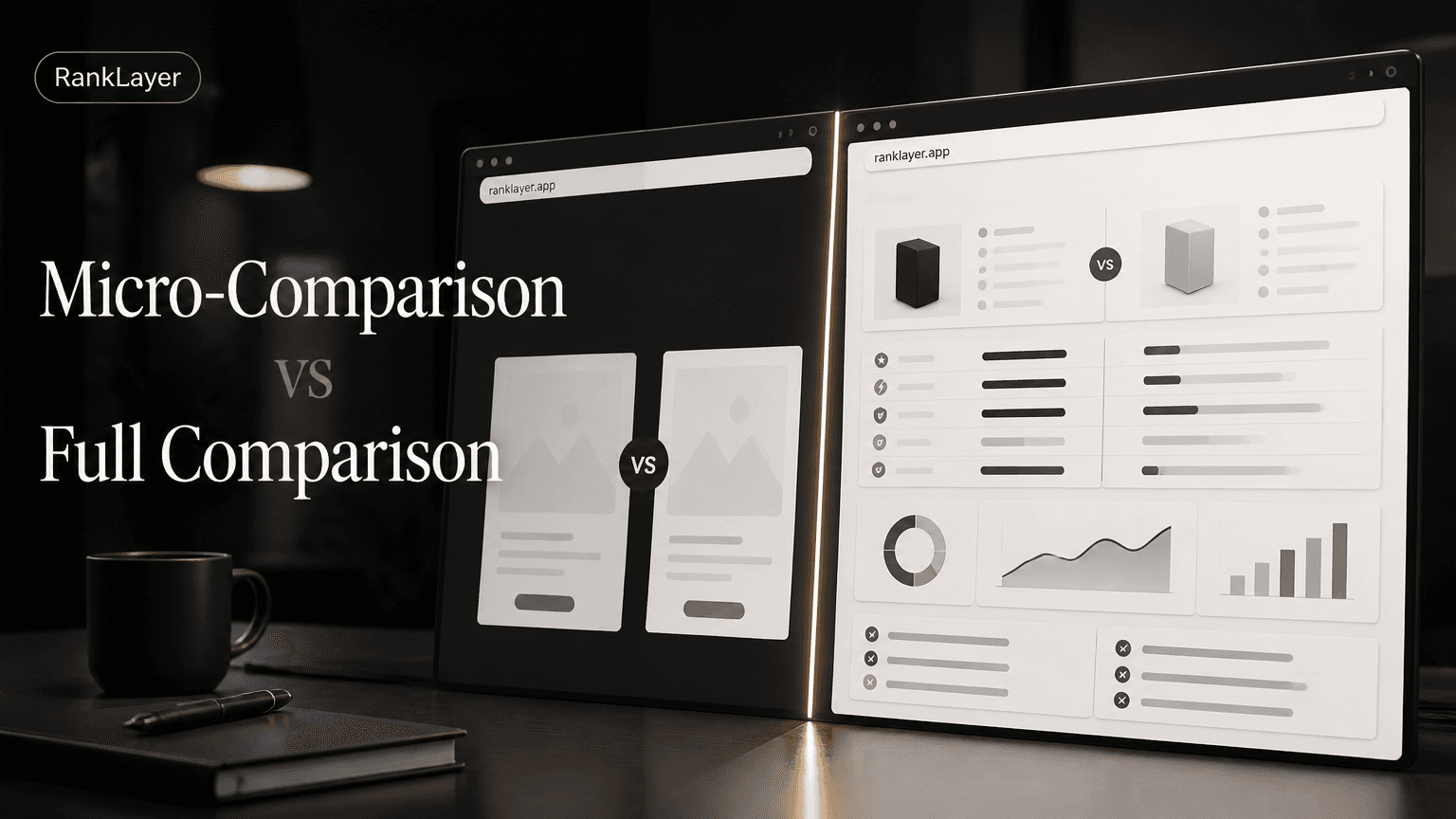
In this article8 sections
- Micro-comparison vs full comparison pages: what is the real difference?
- When should you choose a micro-comparison page?
- When full comparison pages are the better choice
- A practical scorecard for choosing the right comparison format
- How to design both formats for AI citations and buyer conversions
- A seven-day workflow to test 50 micro-comparisons before scaling
- How to measure which comparison format reduces CAC
- Common mistakes and the hybrid strategy that usually wins
Micro-comparison vs full comparison pages: what is the real difference?
Micro-comparison vs full comparison pages is not simply a question of short content versus long content. It is a decision about search intent, information depth, publishing speed, and the next action you want a visitor to take. A micro-comparison answers one narrow buying question, while a full comparison helps someone evaluate an entire decision.
A micro-comparison might answer, “Which running shoe is better for flat feet, Brand A or Brand B?” It usually focuses on one attribute, such as price, speed, fit, integrations, or local availability. A full comparison might cover those same products across 10 or 15 criteria, with a verdict, buyer profiles, evidence, and alternatives.
The distinction matters for AI search. ChatGPT, Gemini, and Perplexity often need a compact, clearly stated fact to answer a specific question. A long article can contain that fact, but it may take more work for a system or reader to identify the relevant passage. Clear headings, specific claims, and self-contained answers make both formats easier to understand.
That does not mean short pages automatically earn more citations. No platform guarantees citations, and Google recommends creating helpful content for people rather than writing only to manipulate rankings. Its official guidance on creating helpful, reliable, people-first content is a useful quality standard for either format.
For a small business, the practical answer is usually a portfolio. Use micro-comparisons to cover many high-intent questions quickly, then use full comparison pages to consolidate authority around the most valuable products, competitors, or categories.
When should you choose a micro-comparison page?
- ✓Choose a micro-comparison when the query contains one dominant decision factor, such as “best budget option,” “faster delivery,” “for beginners,” “with Shopify integration,” or “near me.” The narrower the question, the less useful a 3,000-word article may feel.
- ✓Use this format when you have many products, SKUs, services, neighborhoods, or customer profiles to cover. A local dentist could compare emergency appointment options by availability and payment method, while an online store could create separate pages for lightweight, waterproof, and premium versions of a product.
- ✓Micro-comparisons work well when facts change often. A compact template can be refreshed when price, inventory, delivery time, opening hours, or integrations change. This reduces the risk of leaving outdated details buried in a large evergreen guide.
- ✓Build a micro-comparison when the visitor is close to taking action and needs reassurance, not education. A short “Product A vs Product B for first-time users” page can move a buyer toward a product page, booking form, free trial, or call.
- ✓Prioritize micro-comparisons when you need to test demand before making a larger editorial investment. Publish a controlled group, measure impressions, clicks, assisted conversions, and citation mentions, then expand the winners into full comparisons.
- ✓Do not use the format as an excuse to publish thin pages. Each page still needs a distinct question, accurate data, a clear recommendation, supporting context, and a useful next step. Ten nearly identical pages with swapped product names can create a poor experience and weak indexation signals.
When full comparison pages are the better choice
Full comparison pages earn their place when the buyer is making a complicated or expensive decision. SaaS subscriptions, professional services, medical appointment options, business software, and high-ticket products usually involve several constraints. Readers want to understand tradeoffs before they commit, not just receive a one-line winner.
A strong full comparison typically includes a summary verdict, a comparison table, pricing context, feature differences, ideal customer profiles, limitations, implementation considerations, trust signals, and frequently asked questions. It can also link to more focused micro-comparisons, allowing visitors to investigate the criteria that matter most to them.
Imagine a small e-commerce store selling espresso machines. A micro-page can answer which machine is easier to clean. A full page can compare cost, grinder quality, noise, warranty, counter space, milk steaming, replacement parts, and user skill level. The first page captures a specific moment; the second supports the whole decision.
Full pages are also valuable when your brand needs to explain a point of view. If you sell software, buyers may need to understand why a hosted automatic blog differs from a collection of writing tools, WordPress plugins, and freelance services. That story requires space, examples, and honest limitations.
The tradeoff is production cost. A full comparison takes longer to research, fact-check, design, update, and promote. It can also target too many intentions at once. Before publishing, review the query language in Google Search Console and your analytics data. Google’s Search Console performance documentation explains how impressions, clicks, queries, and pages can be analyzed together.
A useful rule is simple: if the buyer can decide after learning one meaningful difference, start with a micro-comparison. If the buyer needs to balance several differences, build a full comparison.
A practical scorecard for choosing the right comparison format
- 1
Write the buyer’s exact question
Copy the wording customers use in sales calls, chat messages, reviews, and search queries. “Which is cheaper?” suggests a focused page, while “Which platform should my small SaaS choose?” suggests a broader guide.
- 2
Count the decision criteria
List every factor that must be understood before a confident purchase. One or two important criteria usually favor a micro-comparison. Five or more meaningful criteria usually justify a full comparison.
- 3
Score commercial urgency
Give the query a score from 1 to 5 for purchase intent. A phrase such as “A vs B for agencies” may deserve a full page because the audience is specific and valuable. A phrase such as “A vs B weight” may work better as a compact answer.
- 4
Check data stability
If prices, stock, features, or availability change weekly, begin with a refreshable micro-template. Stable products and mature categories are better candidates for a durable full comparison.
- 5
Estimate page distinctiveness
Ask whether the page can provide original value through firsthand experience, customer data, local knowledge, testing, or transparent methodology. If the answer is no, do not multiply the page. Improve the source data first.
- 6
Match the call to action
A micro-page may need one direct CTA, such as “Check availability” or “Start a trial.” A full comparison can support several actions, including a detailed product page, calculator, demo, booking page, or consultation.
- 7
Choose a test batch
Publish 10 to 20 pages in one format and a smaller control group in the other. Keep the offer, tracking, and measurement window consistent so you compare formats rather than random topics.
How to design both formats for AI citations and buyer conversions
The best comparison page gives the answer early, then earns the reader’s trust. Start with a plain-language verdict that names the use case. For example: “Product A is the better choice for shoppers who want lower upfront cost, while Product B is better for buyers who prioritize a longer warranty.” This structure is useful to humans and easy to interpret in an answer context.
Follow the verdict with a small set of verifiable facts. Include the date checked, the source of pricing or specifications, and any conditions that change the recommendation. Avoid vague claims such as “the best option for everyone.” Specificity is more credible and gives readers something they can verify.
Use a consistent microcopy pattern for micro-comparisons: question, direct answer, two or three supporting facts, limitation, and CTA. A 120-word page can still be useful if every sentence helps the buyer decide. For additional headline and opening-line ideas, see these AI citation-focused headline and lead-sentence formulas.
Full comparison pages need stronger information architecture. Place the quick verdict and summary table near the top, then create sections for pricing, capabilities, best-fit users, drawbacks, implementation, and alternatives. Add links from the full page to relevant micro-comparisons, and link back from those micro-pages to the full guide.
Conversion design deserves equal attention. A citation is visibility, not revenue. The page should tell the visitor what to do next, remove one obvious objection, and make the action feel proportionate. A local service provider may use “See appointment times,” while a SaaS company may use “Compare plans” or “Start a free workspace.”
Keep the page public if you want search engines and answer engines to discover it. You can still offer a downloadable checklist after the useful comparison content. The public versus gated content decision guide explains why hiding the entire answer often limits organic discovery.
Finally, measure the page as part of a journey. Track assisted conversions, not only last-click leads. A visitor may discover a micro-comparison through an AI answer, return through a branded search, and convert after reading a full comparison or product page.
A seven-day workflow to test 50 micro-comparisons before scaling
- 1
Day 1: Build the product and question list
Start with 10 to 20 products or SKUs and five buyer questions for each. Good questions include “which is better for small spaces,” “which has faster delivery,” and “which option suits beginners.” Remove any pair that lacks reliable data.
- 2
Day 2: Group questions by intent
Separate price, performance, compatibility, audience, location, and urgency questions. This prevents one template from trying to serve every buyer and makes later reporting much clearer.
- 3
Day 3: Create the content template
Use fields for the question, verdict, supporting facts, evidence date, limitations, CTA, related product links, and FAQ. Require a human check for regulated claims, competitor statements, medical topics, and pricing that changes frequently.
- 4
Days 4 and 5: Publish a controlled batch
With RankLayer, a hosted automatic blog can publish the approved template and product inputs without requiring WordPress or a separate technical team. Publish the first 25 pages, inspect them manually, then release the remaining 25 after fixing repeated phrasing or weak recommendations.
- 5
Day 6: Connect measurement
Connect Google Search Console and Google Analytics to measure impressions, clicks, engagement, and conversions. Add Facebook Pixel or Zapier when retargeting and lead routing matter, and record the exact prompts used for internal ChatGPT, Gemini, and Perplexity citation checks.
- 6
Day 7: Review and choose expansion candidates
Select pages with impressions, qualified visits, assisted conversions, or repeated citation appearances. Expand the best topics into full comparison pages, while refreshing, consolidating, or noindexing pages that show no distinct demand or useful engagement.
How to measure which comparison format reduces CAC
Do not judge micro-comparisons and full comparison pages by traffic alone. A short page may attract fewer visits but produce a higher lead rate because it matches a precise buying question. A long guide may earn more impressions and assisted conversions while producing fewer direct clicks.
Use a simple scorecard with six core metrics: indexed pages, impressions, organic click-through rate, qualified conversion rate, assisted conversions, and cost per qualified lead. Add AI citation rate as a visibility metric, but keep it separate from revenue because citation checks are often sampled rather than complete.
For citation rate, test a fixed prompt set every week. Record whether the business appears, whether the correct page is referenced, which passage seems relevant, and whether the answer contains an inaccurate claim. Use the same location, language, product names, and prompt wording whenever possible.
A practical forecast might look like this: 50 micro-pages receive 8,000 monthly impressions, generate 320 visits at a 4% click-through rate, and convert 3% of those visitors into qualified leads. That produces about 10 leads. A full comparison might receive 2,000 impressions, generate 100 visits at 5%, and convert at 8%, producing 8 leads.
Those numbers are illustrative, not a promise. The micro-pages may win on total lead volume, while the full comparison may win on lead quality or sales close rate. Multiply qualified leads by close rate and average gross profit to compare business value, then subtract content, software, review, and maintenance costs.
RankLayer is useful in this kind of test because its daily publishing model supports a steady page pipeline, while its Google Search Console, Analytics, and internal citation-test workflow can connect visibility signals with actual outcomes. The important part is not publishing 50 pages blindly. It is using the telemetry to decide which page types deserve more investment.
For a more complete attribution setup, combine organic query data with event tracking and CRM outcomes. This guide to tracking AI citations and attributing organic leads contains the measurement concepts, but remove the accidental space before the link when implementing the URL.
Common mistakes and the hybrid strategy that usually wins
- ✓Mistake one is publishing micro-pages that differ only by a product name. Add a genuinely different buyer question, fact set, use case, or recommendation. Otherwise, merge similar intents into one stronger page.
- ✓Mistake two is making full comparison pages encyclopedic. More words do not automatically mean more trust. Remove repetitive feature descriptions and spend that space on evidence, limitations, ownership costs, and who should not choose each option.
- ✓Mistake three is treating AI citations as the only KPI. A citation without a relevant offer, accurate business details, and a measurable CTA may create visibility without customers.
- ✓Mistake four is ignoring freshness. Product prices, inventory, integrations, business hours, and service availability can change quickly. Add a visible checked date and define a refresh rule for every data field.
- ✓Mistake five is hiding the useful answer behind a form. If discovery is the goal, make the core comparison public. Use forms for calculators, personalized recommendations, or implementation help.
- ✓Mistake six is scaling before quality control. Start with a sample, inspect facts and internal links, check for cannibalization, and review whether every page deserves to be indexed.
- ✓The strongest hybrid model is usually a hub and spokes. Build one full comparison for the major category or competitor decision, then publish micro-comparisons for high-value attributes, audiences, locations, and moments. Link them together so readers and crawlers can move from a narrow answer to deeper evaluation.
- ✓For many small businesses, a sensible starting mix is 70% micro-comparisons and 30% full comparisons during validation. After 30 to 60 days of data, shift the mix toward the format that produces qualified pipeline, not merely the format that publishes fastest.
Frequently Asked Questions
Do micro-comparison pages get cited by ChatGPT or Gemini more often than full comparison pages?▼
Not automatically. Micro-comparison pages can be easier to use when an answer requires one specific fact, because the question, verdict, and evidence are tightly connected. Full comparison pages may be cited when the user asks for a broad evaluation or needs several criteria. Test both formats with the same prompt set, and evaluate citation accuracy, linked-page relevance, impressions, and conversions rather than assuming page length determines visibility.
How many micro-comparison pages should I publish for each product or category?▼
Start with three to five distinct buyer questions per product or category, not an arbitrary page count. For a product, those questions might cover price, audience, compatibility, performance, and a common objection. A store with 10 strong products could test 30 to 50 pages, then expand only the questions that show demand, engagement, citations, or qualified leads.
Are full comparison pages better for conversions than micro-comparison pages?▼
They can be, but conversion rate depends on intent and offer fit. Full pages often work well for complex purchases because they resolve several objections in one visit. Micro-pages can convert efficiently when the visitor already knows what they want and needs one final comparison. Measure qualified conversion rate, assisted conversions, sales close rate, and revenue per visitor for both formats.
Can a small business create comparison pages without a website or WordPress?▼
Yes. A hosted blog platform can provide the publishing environment, URLs, templates, and analytics connections without requiring you to build a traditional website. You still need accurate product or service information, a clear business identity, and a conversion path. If you do not have technical skills, a hosted workflow such as RankLayer can reduce setup and publishing work, but it should not replace review and fact checking.
What should a micro-comparison page include to be useful for buyers?▼
Include the exact comparison question, a direct verdict, two or three supporting facts, the intended buyer, one meaningful limitation, a checked date, and one relevant CTA. Add links to the product pages and the broader comparison guide when available. Keep the page short only when the decision is genuinely narrow, because missing context can make a concise page misleading.
How do I prevent micro-comparison pages from competing with one another in Google?▼
Map one primary intent to each URL before publishing. If two pages answer the same question for the same audience, combine them or make the distinction explicit through a different use case, location, product attribute, or season. Review queries and landing pages in Search Console, monitor impressions and clicks, and consolidate pages that repeatedly overlap without adding unique value.
Should I publish the full comparison page first or start with micro-comparisons?▼
Start with micro-comparisons when you have limited data and want to test which attributes buyers care about. Start with a full comparison when the category has obvious commercial demand, the decision is complex, and you already have reliable evidence. A practical sequence is to publish a core full guide, use micro-pages to test specific questions, and update the guide with the winners.
Turn comparison intent into a measurable content pipeline
Explore RankLayerAbout the Author
Vitor Darela de Oliveira is a software engineer and entrepreneur from Brazil with a strong background in system integration, middleware, and API management. With experience at companies like Farfetch, Xpand IT, WSO2, and Doctoralia (DocPlanner Group), he has worked across the full stack of enterprise software - from identity management and SOA architecture to engineering leadership. Vitor is the creator of RankLayer, a programmatic SEO platform that helps SaaS companies and micro-SaaS founders get discovered on Google and AI search engines