Micro-Experiment Playbook: Test 30 Conversational Keywords in 30 Days
A practical 30-day system to discover which questions bring Google visibility, AI citations, and real customer interest.
Get the free experiment checklist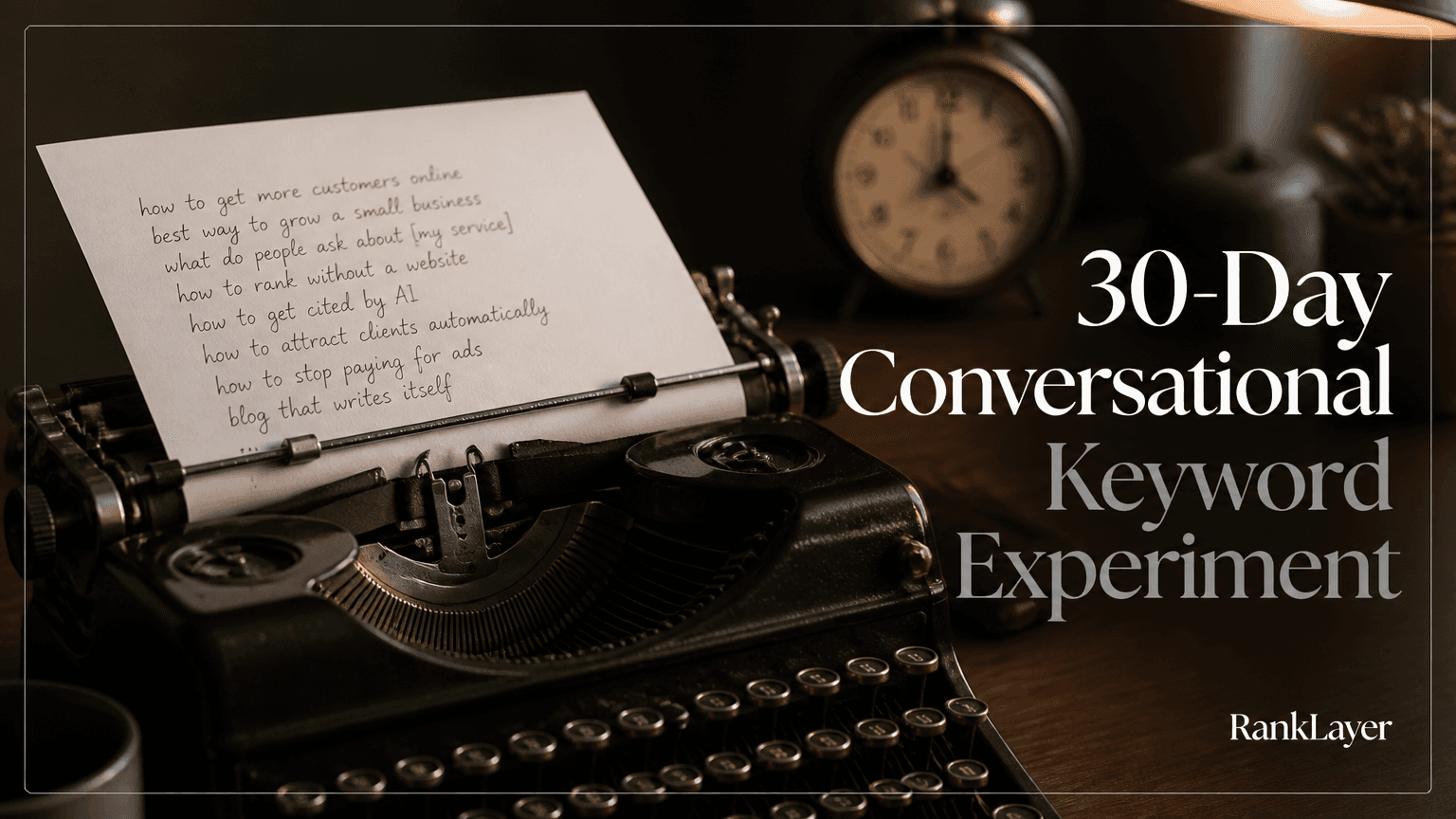
In this article8 sections
- Why conversational keywords matter for Google and AI search
- The 30 conversational keywords to test in 30 days
- How to design one clean keyword experiment per day
- What to test: titles, lead sentences, structure, and trust signals
- How to measure Google rankings, AI citations, and conversions
- A practical 30-day calendar for small businesses
- How to scale winning keywords with RankLayer without lowering quality
- Common mistakes and an automated rollback plan
Why conversational keywords matter for Google and AI search
Conversational keywords are the complete questions people ask in normal language, such as "What is the best accounting software for a small law firm?" or "Where can I get same-day dental cleaning near me?" A 30-day conversational keyword experiment gives you a controlled way to test those questions instead of guessing which topics deserve weeks of content work. The goal is not to publish 30 random articles. It is to learn which combinations of intent, wording, page structure, and business detail make your content useful to both people and answer engines. This matters because search behavior is becoming less mechanical. People still type short phrases, but they also ask full questions in Google, ChatGPT, Gemini, Perplexity, and voice assistants. A detailed question often reveals more intent than a broad keyword. Someone searching for "running shoes" may be browsing. Someone asking "Which running shoes are best for flat feet and daily walking?" has already described a problem, a use case, and a buying filter. AI systems also need clear, extractable information. A page that directly answers a question, explains its assumptions, and provides verifiable business details is easier for a system to understand than a page filled with vague marketing language. This does not guarantee a citation. No ethical SEO process can promise that ChatGPT or Gemini will mention a particular business. It does give your page a better chance of becoming a relevant source when the question matches your expertise. The experiment should therefore measure three layers: visibility, usefulness, and business impact. Track impressions and clicks in Google Search Console, observe whether answer engines surface or cite the page, and connect visits to actions such as calls, bookings, purchases, or demo requests. Google explains how Search Console reports queries, pages, clicks, and impressions in its official performance report documentation, which makes it a useful foundation for the test.
The 30 conversational keywords to test in 30 days
Use the list below as a starting set, then replace the bracketed terms with your real product, service, location, audience, or customer problem. The mix intentionally includes informational, local, commercial, comparison, and decision-stage questions. That variety helps you avoid a common mistake: testing only broad questions that attract attention but rarely lead to a sale. Days 1 to 5, problem discovery: "How do I solve [customer problem]?"; "Why does [problem] keep happening?"; "What should I know before choosing [product or service]?"; "What is the easiest way to [desired outcome]?"; "Can a small business fix [problem] without hiring an expert?" Days 6 to 10, education and trust: "How much does [product or service] usually cost?"; "What is included in [service or package]?"; "How long does [process] take?"; "What questions should I ask a [provider or vendor]?"; "What are the risks of choosing the cheapest [option]?" Days 11 to 15, use cases: "What is the best [product or service] for [audience]?"; "Which [solution] is best for a business with [constraint]?"; "How can [audience] use [product] to achieve [outcome]?"; "Is [solution] suitable for [specific situation]?"; "What is the best option for [season, event, or urgent need]?" Days 16 to 20, local and practical intent: "Who provides [service] near [location]?"; "Where can I buy [product] in [location]?"; "What should I look for in a [local provider] in [location]?"; "Which [service] is open [specific day or time]?"; "How quickly can I get [product or service] in [location]?" Days 21 to 25, comparison and switching: "What is the best alternative to [competitor or current solution]?"; "How does [your category] compare with [another category]?"; "Should I choose [option A] or [option B] for [use case]?"; "What are the pros and cons of [solution]?"; "What should I switch to if [current solution] is too [expensive, slow, or complex]?" Days 26 to 30, conversion and reassurance: "Is [product or service] worth it for [audience]?"; "What is the best [solution] under [budget]?"; "How do I choose a reliable [provider or product]?"; "Can I get [specific outcome] without [common barrier]?"; "What is the next step after choosing [solution]?" Before publishing, apply a simple filter. Keep a keyword if it describes a real customer problem, has a clear answer your business can support, and points to a useful next step. Remove questions that are too broad, impossible to answer accurately, or nearly identical to an existing page. A keyword experiment is only useful when each test teaches you something distinct.
How to design one clean keyword experiment per day
- 1
Assign each query a test ID
Use a consistent naming convention such as CK-01-problem-cost, CK-02-local-speed, or CK-03-alternative-price. Record the exact query, search intent, audience, target URL, publication date, and primary conversion event in one spreadsheet.
- 2
Choose one variable to change
Do not change the title, opening paragraph, schema, internal links, and call to action at the same time. For each page, choose one main experiment variable so you can connect the result to a specific decision.
- 3
Publish a concise answer first
Put a direct answer near the top of the page, then explain the reasoning, exceptions, examples, and next steps. A reader should understand the basic answer in less than a minute, even if the full article takes a deeper look.
- 4
Add evidence and business context
Include prices or price ranges when accurate, service areas, eligibility details, product specifications, dates, credentials, and a clear author or business identity. Specific information makes the page more useful and reduces the risk of generic content.
- 5
Connect the page to the right cluster
Link to one relevant guide, one commercial page, and one supporting question when those pages genuinely help the reader. Avoid creating a giant link menu that feels like a train station with no signs.
- 6
Wait for enough data before judging
Record early indexing and citation observations, but do not call a winner after two days. For a small site, a 30-day test may show directional evidence rather than statistical certainty, so label results as promising, inconclusive, or weak.
What to test: titles, lead sentences, structure, and trust signals
The title is the first practical variable to test because it controls both relevance and expectation. Compare a direct question title, a benefit-led title, and a specific audience title. For example, a bookkeeping firm could test "How Much Does Small Business Bookkeeping Cost?" against "Small Business Bookkeeping Costs: What You Pay For and How to Choose a Provider." Keep the underlying answer the same so you are testing framing rather than rewriting the entire page. The lead sentence deserves its own experiment. Try a one-sentence definition, a direct recommendation, or a conditional answer. "The best invoicing software for a solo consultant is usually the one that combines recurring invoices, payment reminders, and simple tax records" is more useful than "Choosing software can be difficult." Several concise headline and lead patterns can be found in this collection of AI citation focused headline formulas. Next, test answer organization. One version might use a short answer followed by a checklist. Another might use a comparison table, a local service process, or a five-question buying guide. Keep the format aligned with the query. A person asking "how much" needs cost factors and examples. A person asking "which is best" needs decision criteria. A person asking "where" needs location, availability, and contact information. Structured data is another useful variable, but it should describe visible page content rather than act as a secret instruction to search engines. Test valid FAQ, Article, LocalBusiness, or Product markup only when it matches the page and your business. Google’s structured data general guidelines emphasize accuracy, relevance, and consistency between markup and what users can see. Finally, test trust signals. Add a named author, first-hand process details, review methodology, update date, transparent limitations, and links to primary sources where appropriate. For a clinic, that may mean clearly separating general education from medical advice. For an online store, it may mean explaining shipping, returns, materials, and warranty terms. Trust is not decoration. It is part of the answer.
How to measure Google rankings, AI citations, and conversions
- ✓Track indexation first: record whether the URL is indexed, the date it becomes visible in Search Console, and whether the page has impressions. A page that is not discoverable cannot win a citation test.
- ✓Track query and page performance: use impressions, clicks, click-through rate, average position, and branded versus non-branded traffic. Compare each page with its own baseline instead of expecting every query to behave like a high-volume keyword.
- ✓Track AI visibility carefully: run the same neutral prompt in ChatGPT and Gemini at the start, midpoint, and end of the test. Save the date, model or mode, prompt, cited sources, and whether your brand was mentioned, linked, or omitted. Results can vary by location, account, browsing availability, and model update.
- ✓Track citation quality, not just citation count: a mention in an answer that matches your service area and customer need is more valuable than a random brand appearance. Score each observation from zero to three: absent, mentioned, cited as a source, or cited with a useful recommendation.
- ✓Track business actions: connect Google Analytics, forms, booking links, phone events, purchases, or demo requests. A page with 30 clicks and two qualified leads may be more valuable than a page with 300 clicks and no meaningful action.
- ✓Track content risk: monitor duplicate intent, declining clicks on older pages, thin sections, inaccurate claims, and unexpected ranking losses. If two pages answer the same question, consolidate or reframe them rather than publishing a third version.
A practical 30-day calendar for small businesses
- 1
Days 1 to 3, build the test sheet
Choose 30 questions from customer conversations, reviews, support tickets, product knowledge, and local search behavior. Add intent, audience, location, expected action, and a risk note for every query.
- 2
Days 4 to 10, test problem questions
Publish seven pages that explain common frustrations and low-barrier solutions. Watch which wording earns impressions and which pages receive engagement without forcing a sales pitch.
- 3
Days 11 to 17, test use cases
Publish seven audience-specific pages, such as a solution for solo professionals, busy parents, new store owners, or small teams. Specific audiences often produce clearer conversion signals than generic category pages.
- 4
Days 18 to 24, test local and comparison intent
Publish local availability questions and careful comparison content. Be factual, disclose limitations, and avoid unsupported claims about competitors. These pages can attract strong intent, but they also need the most human review.
- 5
Days 25 to 27, review the signals
Sort pages by indexation, impressions, clicks, AI citation observations, engagement, and conversions. Mark each page as scale, revise, hold, or retire. Do not scale a page solely because it received one unverified AI mention.
- 6
Days 28 to 30, make the next batch
Create a second set of questions from winning patterns. If local questions performed well, add nearby service variations. If cost questions performed well, build budget and package pages. If a topic failed, improve the intent match before abandoning the whole category.
How to scale winning keywords with RankLayer without lowering quality
Once you have completed most of the test, automation becomes useful because the hard part is no longer finding something to publish. The hard part is repeating what worked without producing 100 near-duplicate pages. RankLayer is designed for this kind of workflow: it provides a hosted AI blog, daily publishing, SEO-focused templates, and connections such as Google Search Console and Google Analytics, so a small business can keep the publishing system running without building WordPress or managing a separate website stack. Start by promoting patterns, not individual URLs. If three pages about "best option for [audience]" earn impressions and qualified visits, create a controlled template for that intent. Keep stable fields for the answer, proof, limitations, business details, and call to action. Vary only the facts that genuinely change by audience, product, service, or location. This is how you avoid the dreaded content factory where every page sounds like the same robot wearing a different hat. Use a page scorecard before automatic expansion. A practical threshold could require indexation, at least one meaningful Search Console signal, no cannibalization warning, a factual review, and a conversion path. For citation experiments, add a repeatable prompt log and require observations across more than one date. The LLM readability rubric can help you review whether a page is clear enough for both human readers and AI retrieval systems. RankLayer can then publish the next group of related articles on a daily cadence while Search Console and analytics data show which topics deserve attention. Use your own judgment for sensitive subjects, regulated advice, pricing changes, and competitor claims. Automation should remove repetitive production work, not remove responsibility for accuracy.
Common mistakes and an automated rollback plan
The first mistake is treating AI citation as a binary ranking position. ChatGPT and Gemini do not provide a single stable leaderboard, and a citation can disappear when the prompt, user context, browsing state, or model changes. Keep a dated evidence log, report trends rather than guarantees, and use organic traffic and leads as the business baseline. The second mistake is changing too many variables at once. If you rewrite the title, add new schema, change the URL, insert five links, and alter the call to action on day 15, you will not know what caused the result. Use version labels such as v1-title-question, v2-title-audience, and v3-lead-direct-answer. Store the old copy before every change. The third mistake is publishing all 30 pages without checking intent overlap. A local dentist might create separate pages for "best dentist near me," "top dentist near me," and "reliable dentist near me" even though the searcher wants the same answer. Group close variants, give each page a distinct purpose, and merge weak pages when they compete with one another. A keyword cannibalization checker guide provides a useful review process for this problem. Use this rollback plan when a page causes trouble. First, freeze expansion from the affected template. Second, compare the new version with the last stable version and inspect indexation, canonical tags, internal links, and conversion events. Third, restore the stable version or redirect a genuinely redundant page, then monitor impressions and clicks for at least seven days. Finally, record what failed and update the template rule so the same issue does not spread to the next 30 pages. A safe experiment has an exit ramp. That simple habit protects rankings, customer trust, and your sanity while still giving you room to learn quickly.
Frequently Asked Questions
Which conversational keywords should I prioritize for AI citation tests?▼
Start with questions that combine a clear problem, a specific audience, and a practical decision. Queries containing words such as best, cost, near me, alternative, how long, and what should I look for often reveal stronger intent than broad category terms. Prioritize questions your business can answer with first-hand details, accurate facts, and a useful next step. Test a balanced mix of educational, local, comparison, and conversion-oriented queries rather than focusing only on one format.
How do I know whether ChatGPT or Gemini is citing my page?▼
Run a consistent set of neutral prompts and record the date, exact wording, model or mode, location, cited URLs, brand mentions, and whether your page was linked. Repeat the checks at planned intervals because answer results can change with context, browsing availability, and model updates. Treat manual checks as directional evidence, not a guaranteed measurement of total visibility. Combine them with Search Console, analytics, referral data, and lead tracking to understand whether the visibility is commercially useful.
How long should a conversational keyword experiment run?▼
Thirty days is a practical starting point because it gives you time to publish, allow discovery, observe early impressions, and compare several page types. New or lightly established sites may need longer before the results become meaningful. Use the first week to check technical problems and indexing, the middle weeks to collect directional signals, and the final days to decide what to scale. Avoid declaring a permanent winner based on a single impression spike or one AI answer.
What page elements should I change in a conversational keyword test?▼
Test one major variable at a time, starting with the title, lead sentence, answer format, trust signals, internal links, or structured data. Keep the URL and core facts stable when possible so the result is easier to interpret. Match the variable to the query: test cost examples for price questions, comparison criteria for best-option questions, and service area details for local questions. Always make sure the revised version remains accurate and helpful before measuring performance.
Can I run a 30-day keyword experiment without a website?▼
Yes, you still need a public, crawlable place where your answers can live, but that does not require building a full WordPress site. A hosted AI blog or branded subdomain can provide pages, metadata, internal links, analytics connections, and a path for customers to contact you. The important requirements are accessibility, clear business identity, useful content, and reliable measurement. If you are starting from zero, first review this framework for choosing seed keywords without a website.
How do I scale winning keywords without creating thin content?▼
Scale the underlying intent pattern only after several pages show evidence of demand, relevance, or qualified engagement. Build a template with fixed quality requirements, then vary only information that genuinely changes by customer, product, service, or location. Add human review for regulated topics, pricing, medical or legal information, and competitor comparisons. Prune, merge, or improve weak pages instead of assuming more URLs automatically create more authority.
Turn 30 questions into your next month of visibility
Explore the RankLayer playbookAbout the Author
Vitor Darela de Oliveira is a software engineer and entrepreneur from Brazil with a strong background in system integration, middleware, and API management. With experience at companies like Farfetch, Xpand IT, WSO2, and Doctoralia (DocPlanner Group), he has worked across the full stack of enterprise software - from identity management and SOA architecture to engineering leadership. Vitor is the creator of RankLayer, a programmatic SEO platform that helps SaaS companies and micro-SaaS founders get discovered on Google and AI search engines