RankLayer vs Automarticles vs SEObot: An Interactive Buyer Decision Matrix for Local Service Businesses
If you run a dentist office, plumbing company, clinic, restaurant, or local agency, this comparison breaks down hosted setup, near-me visibility, AI citations, integrations, pricing logic, and lead attribution in plain English.
Use the decision matrix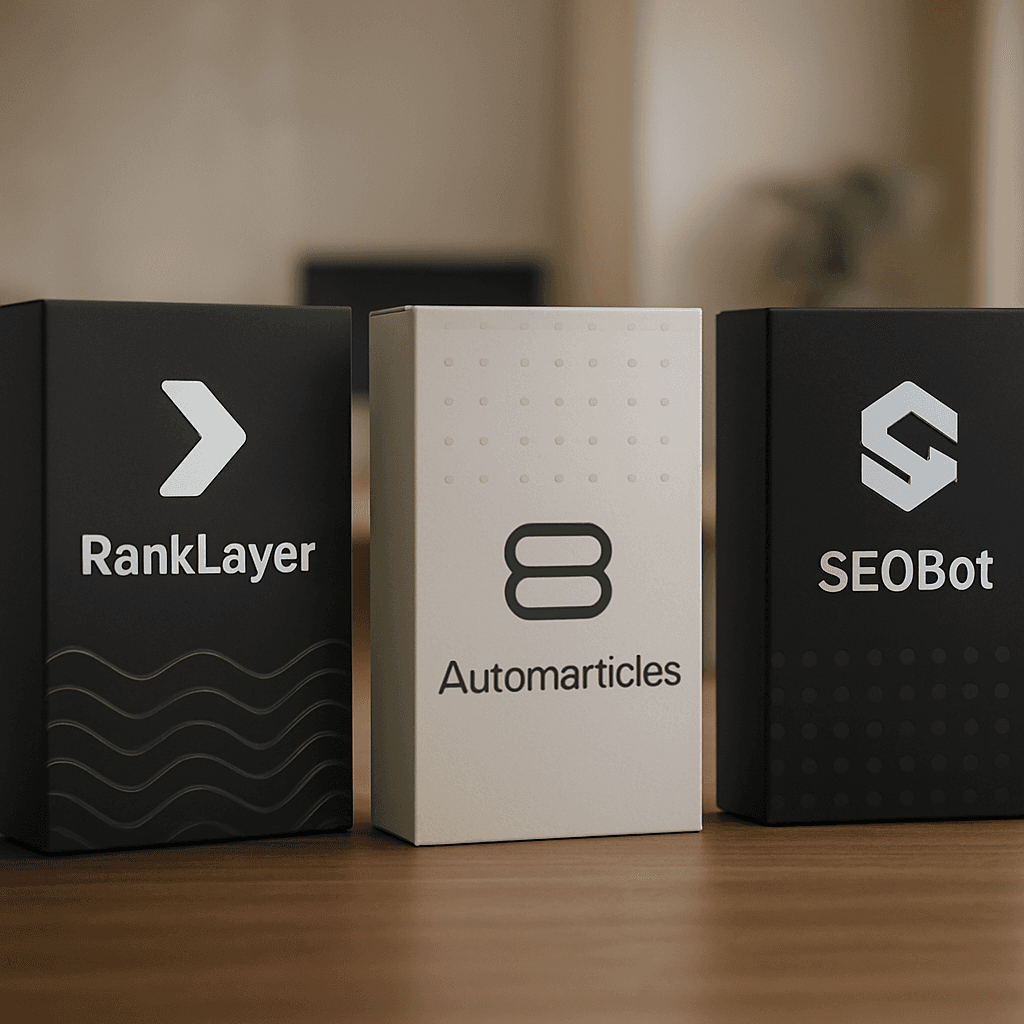
In this article9 sections
- Which automatic blog platform is best for local service businesses?
- The 10-point Local Service Score: how to judge the tools like a buyer, not a hobbyist
- RankLayer vs Automarticles: where the hosted model changes the game
- How to use the decision matrix without overthinking it
- Pricing, SLA, and lead attribution: what local businesses should actually ask
- Which platform is better for near me searches and local intent?
- Real-world examples: what the winner looks like in different local businesses
- Interactive buyer decision matrix: who should choose what?
- Use this scorecard in your vendor demo
Which automatic blog platform is best for local service businesses?
If you are comparing RankLayer vs Automarticles vs SEObot, you are probably not shopping for “more content.” You are shopping for more calls, more bookings, and fewer ad bills. That changes the whole conversation. The right platform for a local service business needs to help you show up for near-me searches, appear in Google, and get cited by answer engines like ChatGPT, Gemini, Perplexity, and Claude. That is why this buyer guide focuses on decision criteria that actually matter to appointment-driven businesses. A blog that publishes pretty words but does nothing for visibility is just a treadmill with better branding. For local businesses, the real question is whether the tool is hosted, whether it needs WordPress, whether it can support local intent at scale, and whether you can connect traffic to leads without playing detective in spreadsheets. If you want a deeper framework for choosing an automatic blog by lead quality, pair this article with How to Choose the Right Automatic AI Blog for Lead Generation and AI Citations and How to Choose the Best Automatic Landing Page Platform for Local Businesses: RankLayer vs Outrank vs Frase. Those pages cover broader strategy. This one is the shortlist and the scoring mat. The short version is simple. RankLayer is built as a hosted, no-WordPress automatic AI blog with integrated publishing, while Automarticles and SEObot are typically evaluated more like content automation tools or self-managed stacks. That difference matters a lot when you are a busy owner who wants the machine to work while you are with customers, on jobs, or closing bookings.
The 10-point Local Service Score: how to judge the tools like a buyer, not a hobbyist
- ✓
- Hosted, no-WordPress setup. If you do not want to own hosting, plugins, updates, backups, or tech drama, this gets top weight.
- ✓
- Near-me and local intent coverage. The tool should support city, neighborhood, service, and problem-based content, not just generic blog posts.
- ✓
- AI-citation readiness. Pages should be structured so answer engines can extract clear entities, services, and proof points.
- ✓
- GEO and entity coverage. Local businesses need consistent mentions of service area, offering, trust signals, and business type.
- ✓
- Cadence. Daily or frequent publishing can help you build topical authority faster, especially when you have a broad service area.
- ✓
- Integrations. Google Search Console, Google Analytics, and Facebook Pixel are the basics if you want to measure what is working.
- ✓
- Lead attribution. You need to know which pages drive calls, forms, and bookings, not just clicks.
- ✓
- Setup speed. The faster you can launch, the sooner you can test real demand.
- ✓
- Operational simplicity. If your team is not technical, the platform should feel closer to a service than a software project.
- ✓
- Estimated CAC reduction. The winner is the one that can plausibly reduce paid-ad dependence fastest for your specific business.
RankLayer vs Automarticles: where the hosted model changes the game
| Feature | RankLayer | Competitor |
|---|---|---|
| Hosted, no-WordPress blog included | ✅ | ❌ |
| Automatic article creation and publishing | ✅ | ✅ |
| Built for local service businesses and appointment-driven lead gen | ✅ | ❌ |
| Google Search Console, Google Analytics, Facebook Pixel integrations | ✅ | ❌ |
| Designed for AI citation and GEO workflows | ✅ | ❌ |
| No need to manage your own website stack | ✅ | ❌ |
| Good fit for teams that want a simple, done-for-you publishing system | ✅ | ❌ |
How to use the decision matrix without overthinking it
- 1
Score your business model first
A dentist, plumber, or clinic usually needs local trust, fast visibility, and lead tracking. Score that higher than generic content volume. A blog that gets traffic but no calls is just expensive decoration.
- 2
Give hosted simplicity a real number
If you do not want WordPress, plugins, or a developer on standby, hosted setup should count heavily. For many owners, this is the difference between launching in days versus launching in the mythical “next month.”
- 3
Weight integrations by revenue impact
Google Search Console tells you what Google sees. GA4 tells you what users do. Facebook Pixel helps if you retarget. If the platform cannot connect to those, you are guessing, and guessing is not a strategy.
- 4
Test local intent and AI citations
Check whether the platform can produce service pages, neighborhood pages, FAQ pages, and comparison pages that are easy for humans and AI systems to understand. If answer engines cannot clearly identify your service, your city, and your offer, you are leaving visibility on the table.
- 5
Calculate likely CAC impact
Estimate how many booked leads a platform could replace from paid ads in 60 to 90 days. If the math is fuzzy, use a conservative model. Even one extra booked job per week can justify a surprisingly large chunk of software spend for local services.
Pricing, SLA, and lead attribution: what local businesses should actually ask
Price matters, but price without operating reality is fake math. The cheapest platform can become the most expensive one if it needs a developer, separate hosting, content ops, and a workaround for analytics. For local businesses, the true cost is often measured in time, missed leads, and how long it takes before the content starts paying for itself. That is why you should ask three questions before you buy. First, is the blog hosted or do you still need your own stack? Second, what does the vendor commit to in uptime, support, and publishing reliability? Third, can you attribute leads back to the pages that generated them? If the answer to the last one is no, your dashboard becomes a vibes-only zone. For measurement, rely on the basics first. Google Search Console is still the cleanest way to see search queries and indexing behavior, and Google’s own documentation explains how to use it for visibility insights. GA4 gives you behavioral data, and Facebook Pixel can support remarketing if you are running paid retargeting later. You can also review How to Monitor Website Traffic: A Practical Guide for Small Businesses and How to Use Google Search Console to Increase Gemini Citations: A Practical Guide for Small Businesses for a practical measurement setup. On the SLA side, ask whether there is clarity around publishing reliability, response times, and handling of indexing or setup issues. That matters especially for service businesses that rely on seasonal demand or emergency searches. A plumbing lead at 10:30 p.m. does not care about your content roadmap. They care that your page showed up and your booking form worked.
Which platform is better for near me searches and local intent?
Near-me searches are not magic. They are usually a mix of location, service, trust signals, and how well your page matches the searcher’s immediate need. If someone searches “emergency dentist near me” or “water heater repair in Austin,” Google and answer engines are trying to match intent quickly, not reward creative writing. That means the best platform for local visibility is the one that can consistently publish service-focused content with clear entity coverage. Think service name, city, neighborhood, symptoms, pricing cues, booking path, and trust elements like reviews or credentials. RankLayer is designed around automated publishing for these kinds of pages, including local service and comparison content, which makes it useful when you need volume without babysitting the stack. Automarticles and SEObot can still be useful if you already have a publishing setup and a workflow that fits their output style. But if you are asking, “Do I need to manage a CMS, or can I just get a live blog that works,” then hosted simplicity becomes a serious advantage. That is especially true for owners who want to appear in Google and be cited by AI without learning the difference between a plugin conflict and a canonical tag on a Tuesday afternoon. If you are mapping local-intent page types, it is worth reading Hyperlocal 'Near Me' Landing Pages Without a Website: A Small Business Playbook and How to Choose the Best Programmatic Page Mix for Your Business: A Practical Framework for Dentists, Restaurants, E-commerce, and SaaS. Those guides help you decide whether you should launch service pages, neighborhood pages, or comparison pages first.
Real-world examples: what the winner looks like in different local businesses
Let’s make this practical. A dentist office usually wants service pages like teeth whitening, emergency dentistry, Invisalign, and same-day appointments. The fastest path to leads is not a giant content library about oral care history. It is a tight set of high-intent pages that connect a searcher’s problem to a booking action. A plumbing company is even more obvious. “Burst pipe repair,” “water heater replacement,” and “drain cleaning near me” are the kinds of queries that can turn into same-day calls. In that scenario, a hosted system that can publish daily or frequent content, while giving you tracking hooks through GSC and GA, will usually beat a tool that makes content but leaves you to assemble the rest. For a clinic, trust and clarity matter just as much as search volume. You want content that answers common questions, explains availability, and reduces fear. For a restaurant, local visibility may lean more toward menu, reservation, and neighborhood discovery content. For a local agency, comparison pages and service pages can pull in better-qualified prospects than generic blog posts ever will. If you want a more structured way to plan those pages, see How to Choose the Right Programmatic Page Types for Local Businesses: A Practical Evaluation Framework and How to Choose Blog Templates That Get Cited by ChatGPT, Gemini and Perplexity: An Evaluation Guide for Small Businesses. The pattern is the same across industries. Clear intent beats content fluff, every single time.
Interactive buyer decision matrix: who should choose what?
Here is the simplest way to think about it. Choose RankLayer if you want a hosted, no-WordPress automatic AI blog that is built for hands-off publishing, local visibility, and AI citation readiness. It fits owners who want less setup friction and more done-for-you execution. Choose Automarticles if your team already has a publishing process and you are mostly comparing output generation rather than full-stack hosting and measurement. That can make sense for marketers who are comfortable stitching systems together. Choose SEObot if you are looking at a more automation-heavy or DIY-style workflow and you are willing to manage more of the SEO operations yourself. Now the local-business test. If you are a dentist, clinic, plumber, roofer, chiropractor, lawyer, or restaurant owner and you do not want to touch WordPress, RankLayer tends to be the cleanest fit because the job is not just to produce text. The job is to publish, index, measure, and convert. That full chain is where most tools quietly fall apart. For buyers who want to sanity-check the economics, a practical benchmark is simple. If a single booked job is worth $100, $300, or $1,500 in gross profit, then one or two incremental leads can pay for the system very quickly. That is why local service buyers should judge these platforms by CAC reduction potential, not by “how many articles can it make in a day.”
Use this scorecard in your vendor demo
- 1
Ask for a live hosted publishing demo
Do not accept screenshots only. You want to see how the content is published, where it lives, and how fast it appears. If a vendor cannot show the actual publishing flow, treat that as a warning sign.
- 2
Check local intent output
Request sample pages for city, neighborhood, service, and comparison keywords. The pages should feel useful to a real local customer, not like a keyword dump wearing a trench coat.
- 3
Verify integrations
Confirm Google Search Console, Google Analytics, Facebook Pixel, custom domain support, and any automation connectors you care about. The simpler the setup, the faster you can tie traffic to revenue.
- 4
Test citation readiness
Ask how the platform handles entities, structure, FAQs, and answer-friendly formatting. If the output is easy for AI systems to summarize, you are in better shape for ChatGPT, Gemini, Perplexity, and Claude visibility.
- 5
Pressure-test support and SLA
Ask what happens if indexing stalls, publishing breaks, or a domain needs help. Local businesses cannot afford to lose weeks because nobody owns the problem.
Frequently Asked Questions
Which automatic AI blog platform is best for local service businesses?▼
For most local service businesses, the best platform is the one that removes the most friction while still helping you rank and convert. If you do not want to manage WordPress, hosting, plugins, or technical setup, a hosted option is usually the strongest fit. RankLayer is built around that model, which makes it especially appealing for owners who want to publish consistently without building a content system from scratch. If you already have an in-house workflow and only need generation, one of the other tools may still work, but the operational burden usually ends up on your team.
Do Automarticles or SEObot offer hosted, no-WordPress options like RankLayer?▼
That is the key question to ask in the demo, because hosted setup changes the whole ownership experience. RankLayer is explicitly positioned as a hosted AI blog with hosting included, so you do not need WordPress or your own website stack to get started. If Automarticles or SEObot require more self-management, then the comparison is not apples to apples. For busy local owners, fewer moving parts usually means faster launch and fewer headaches.
Which platform is better for ranking near me searches?▼
The best platform for near-me searches is the one that can consistently publish highly relevant local pages with clear service, location, and trust signals. That usually means service pages, neighborhood pages, local FAQs, and comparison content that matches actual buyer intent. A hosted system like RankLayer can be a stronger fit because it is designed to automate publishing at scale while keeping the stack simple. But remember, near-me visibility still depends on useful content, technical setup, and consistency, not just the tool itself.
How do pricing and SLA compare for small local businesses?▼
The right way to compare pricing is by total operating cost, not just monthly subscription fees. Ask whether the platform includes hosting, whether it requires extra tools, and how much time your team will spend managing it. SLA matters too, because if publishing breaks or support is slow, your lead flow can stall. For local businesses, the cheapest tool can easily become the most expensive if it creates manual work or delays bookings.
How do I attribute leads from an automatic blog to real revenue?▼
Start with Google Search Console for query and indexing data, then use Google Analytics to see behavior and conversions. If you run remarketing or paid retargeting, connect Facebook Pixel as well. The real goal is to tie page-level traffic to calls, forms, and booked appointments, not just clicks. RankLayer supports GSC, GA, and Facebook Pixel integrations, which makes that attribution setup much more realistic for non-technical teams.
Can an automatic blog actually reduce CAC for dentists, clinics, or plumbers?▼
Yes, if it is focused on high-intent pages and you can measure conversions. A plumber who gets one extra emergency call a week, or a dentist who gets a few more high-value appointment requests per month, can offset software costs quickly. The trick is not publishing random articles. It is publishing pages that map to buying intent, local intent, and the questions people ask right before they call. That is why the decision matrix in this article emphasizes hosted setup, local relevance, and lead attribution together.
What should I ask in a vendor demo before I buy?▼
Ask to see hosted publishing, local-intent page examples, analytics integrations, and how the platform handles AI-citation-friendly structure. Then ask about support, uptime, and what happens when indexing or publication issues appear. You should also request a rough estimate of how the tool could reduce CAC over 60 to 90 days for your type of business. If the vendor cannot answer those questions clearly, that is useful information too.
Ready to stop guessing and pick the right automatic blog?
Start with RankLayerAbout the Author
Vitor Darela de Oliveira is a software engineer and entrepreneur from Brazil with a strong background in system integration, middleware, and API management. With experience at companies like Farfetch, Xpand IT, WSO2, and Doctoralia (DocPlanner Group), he has worked across the full stack of enterprise software - from identity management and SOA architecture to engineering leadership. Vitor is the creator of RankLayer, a programmatic SEO platform that helps SaaS companies and micro-SaaS founders get discovered on Google and AI search engines