How to Choose Between Daily Automated AI Blog Posts and Short-Term Paid Ads
Compare speed, cost, lead quality, Google visibility, and AI citations without relying on guesswork or vanity metrics.
Start your measurable growth experiment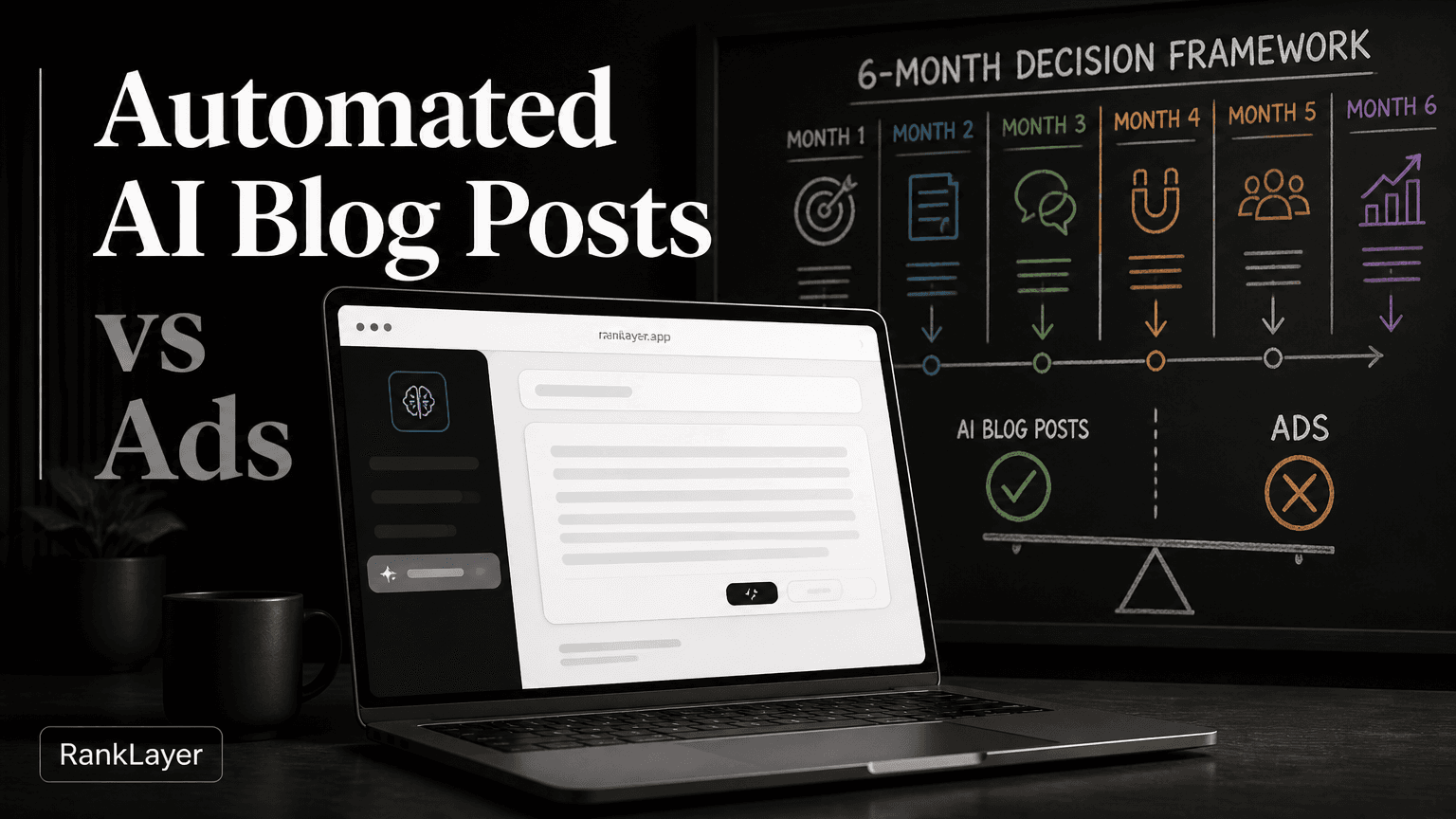
In this article9 sections
- Why a 6-month framework beats a quick channel switch
- Daily AI blog posts vs paid ads: the tradeoffs that actually matter
- How to compare CAC and payback period for both channels
- The 6-month decision framework, month by month
- The tracking setup that proves whether content is replacing ad spend
- A practical ROI calculator for a six-month channel test
- Decision rules for the most common small-business situations
- Common mistakes that make the six-month test useless
- The best answer is often a staged channel portfolio
Why a 6-month framework beats a quick channel switch
Daily automated AI blog posts and paid ads solve different parts of the customer acquisition problem. Paid ads can put an offer in front of a ready-to-buy audience within hours, while an automated AI blog builds a searchable library that may attract visitors for months or years. The right choice depends on your cash flow, sales cycle, margins, and tolerance for delayed results.
The mistake is judging both channels by the same short-term scoreboard. An ad campaign is usually evaluated by clicks, conversions, and immediate revenue, while organic content needs time for crawling, indexing, rankings, repeat visits, and brand recognition. If you pause ads after two weeks because organic traffic is still small, or publish content for six months without tracking leads, you are not running a fair test.
This 6-month decision framework gives you a practical way to compare the two. You will establish a paid baseline, launch a controlled daily content program, measure assisted conversions, and decide whether to keep ads, reduce them, or use both together.
For a small business without a marketing team, the operational difference matters just as much as the media cost. A hosted platform such as RankLayer can create and publish optimized articles each day without WordPress, a separate website, or technical setup, but you still need a clear offer, accurate business information, and a lead-handling process.
Before you begin, define one commercial goal. It might be 30 qualified calls per month for a dental clinic, 50 profitable orders for an online store, or 20 product demos for a SaaS company. Traffic is useful only when it moves that goal.
Daily AI blog posts vs paid ads: the tradeoffs that actually matter
- ✓Speed to first demand: Paid ads usually win because impressions and clicks can begin shortly after approval. Daily AI content is slower, especially for a new hosted blog, because search engines need to discover, crawl, index, and evaluate pages.
- ✓Cost structure: Ads charge you repeatedly for exposure and clicks. An automated blog has a recurring platform cost and an operating cost for review, but each published page can continue attracting organic visits after its first month.
- ✓Intent coverage: Ads are strongest when you already know the exact commercial query and can create a focused landing page. A daily blog can cover informational, local, comparison, seasonal, and conversational questions that paid campaigns may not target efficiently.
- ✓Control: Paid platforms offer precise budgets, audiences, locations, schedules, and creative tests. Organic content offers less control over timing and ranking, but it can build a durable discovery asset that is not switched off when the budget reaches zero.
- ✓Trust and authority: A useful library of transparent answers can support credibility in Google and help your business become a relevant source for AI tools such as ChatGPT, Gemini, Perplexity, and Claude. No content system can guarantee citations, so treat AI visibility as an outcome to measure, not a promise.
- ✓Lead quality: Ads can produce fast leads, but quality may vary with targeting and keyword settings. Organic visitors often arrive through more specific questions, which can improve relevance, although you must still inspect calls, forms, bookings, and sales rather than assuming every organic lead is valuable.
- ✓Operational effort: Ads need ongoing bid, creative, search term, and conversion management. Automated publishing reduces writing work, but humans should review sensitive claims, pricing, regulated advice, brand language, and important product details.
How to compare CAC and payback period for both channels
Start with the economics of one new customer, not the cost of a click. Your maximum acceptable acquisition cost is the gross profit you can reasonably allocate to acquiring a customer while preserving cash for delivery, support, refunds, and overhead.
Use this basic model for each channel:
Channel CAC = total channel cost ÷ number of new customers attributed to that channel
Payback period in months = channel CAC ÷ monthly gross profit per customer
For example, imagine a local service business spends $1,500 per month on ads and gets 15 new customers. Its ad CAC is $100. If each customer produces $250 in gross profit during the first month, the payback period is 0.4 months. That may be an excellent use of ads even if an automated blog could eventually reduce acquisition costs.
Now suppose the same business spends $299 per month on a hosted AI blog, plus $200 of owner time for review and lead follow-up. In month six, the blog has generated 12 customers. Its simple cumulative CAC is $2,994 divided by 12, or $249.50. That looks worse than the ad result, but the calculation should also include the ongoing value of pages that remain published and continue producing leads.
Do not force a winner before the data is mature. Track monthly CAC, cumulative CAC, customer gross profit, payback period, lead-to-customer rate, and revenue by first touch and assisted touch. A useful keyword ROI scorecard for conversion and AI citation potential can help you avoid filling a content calendar with topics that attract attention but have no commercial path.
Paid ads also have opportunity costs. If your campaign requires constant creative production, agency management, landing page work, and customer service follow-up, include those costs. For organic content, include review time, offer updates, internal linking, analytics checks, and occasional content refreshes instead of treating the platform subscription as the entire investment.
The 6-month decision framework, month by month
- 1
Month 0: establish a clean paid baseline
Record the previous 60 to 90 days of ad spend, impressions, clicks, leads, qualified leads, customers, revenue, and gross profit. Separate branded and nonbranded campaigns, document landing pages, and confirm that phone calls, forms, bookings, purchases, and trial signups are being captured.
- 2
Month 1: launch content around commercial questions
Choose 20 to 30 topics connected to real customer questions, products, services, locations, use cases, and objections. Publish consistently, add a clear conversion path to every page, and connect Google Search Console and Google Analytics before judging performance.
- 3
Month 2: verify technical health and early intent
Check whether pages are being discovered and indexed, then review impressions, queries, average position, engaged sessions, and assisted conversions. Do not expect large organic revenue yet, but remove weak topics, correct inaccurate details, and improve pages that receive impressions without clicks.
- 4
Month 3: run a controlled budget test
Keep high-performing ads running, but reduce or pause one carefully selected nonbranded campaign for two to four weeks if your cash flow allows. Compare total qualified demand, not just paid conversions, because some people may discover your content after seeing your brand elsewhere.
- 5
Month 4: improve the pages that show buying intent
Use Search Console query data to identify pages ranking for product, service, price, location, comparison, and solution terms. Strengthen calls to action, add proof, answer objections, and connect related pages so visitors can move from research to inquiry.
- 6
Month 5: measure assisted revenue and AI visibility
Review first-touch, last-touch, and assisted conversion reports. Test a fixed set of relevant prompts in ChatGPT, Gemini, Perplexity, and Claude, recording whether your business or pages are mentioned, but never treat an AI citation as a customer until it produces measurable traffic or a lead.
- 7
Month 6: make a budget decision with guardrails
Compare six-month cumulative CAC, payback, qualified lead rate, customer value, and channel stability. Keep ads for urgent demand or proven high-margin terms, shift budget toward content when organic demand is repeatable and profitable, or use a hybrid allocation when each channel performs a different job.
The tracking setup that proves whether content is replacing ad spend
A trustworthy experiment begins with consistent naming. Create separate campaign names for paid search, paid social, organic blog, direct traffic, referrals, and AI referral traffic where your analytics platform can identify it. Use the official Google Analytics campaign URL builder for links in ads, social posts, emails, QR codes, and partner placements.
In Google Search Console, monitor clicks, impressions, click-through rate, average position, and the queries that bring users to your pages. Search Console is especially useful for finding unexpected long-tail demand, such as “same-day emergency dentist near me” or “best inventory tool for a small Shopify store,” which can inform your next articles and landing pages.
In Google Analytics, create conversion events for form submissions, booking confirmations, phone link clicks, checkout completion, trial activation, and qualified lead status when possible. Mark the events that represent real business value, rather than counting every page view as a conversion.
For paid social retargeting, install the Meta Pixel only with appropriate consent and privacy disclosures. Meta explains its Pixel and Conversions API measurement options, but your implementation should also follow the laws and consent requirements that apply to your customers and location.
A simple Zapier workflow can connect the lead form to a spreadsheet or CRM. The trigger is “new lead submitted”; the actions are “create or update contact,” “add source and landing page,” “notify the owner,” and “start a follow-up task.” Add fields for first touch, last touch, landing page, service or product, location, lead quality, and closed revenue.
For example, a lead who reads a RankLayer article about “how much does emergency roof repair cost” and then books through a separate service page should not disappear into a generic “organic” bucket. Store the article URL, the conversion page, and the eventual sale so you can see which topics influence revenue.
A practical ROI calculator for a six-month channel test
Build the calculator in a spreadsheet with one row for each month and separate columns for paid and organic activity. The minimum inputs are ad spend, blog subscription cost, content review hours, hourly owner cost, clicks or sessions, leads, qualified leads, customers, average order value, gross margin, and refunds.
For paid ads, calculate direct customer revenue minus ad spend and campaign labor. For the automated blog, calculate customer gross profit minus platform cost, review labor, analytics tools, and any promotion or link-building expense. Keep revenue and gross profit in separate columns, because a high-revenue product with thin margins can create a misleading victory lap.
Add a content asset column that tracks the cumulative number of published pages. If RankLayer publishes one article each day, the theoretical cadence is about 180 posts across six months, subject to your selected schedule and quality controls. The number alone is not the goal; a smaller set of accurate, useful pages can outperform a large collection of repetitive posts.
To model an AI-citation uplift without inventing certainty, use three scenarios: zero uplift, a conservative uplift, and an observed uplift. For instance, if your baseline produces 100 monthly qualified organic sessions, model 0 percent, 10 percent, and 25 percent additional qualified sessions from AI discovery, then replace the assumptions with measured data as soon as you have it.
Your spreadsheet should answer four questions: How much did each customer cost? How quickly did the channel repay that cost? How many qualified opportunities did it create? What happens to demand if you stop spending next month?
You can also calculate a blended result. If ads generate 20 customers and content generates 8 customers, divide the total six-month marketing investment by 28 only after applying a documented attribution rule. Run sensitivity checks for undercounted phone calls, delayed sales, repeat purchases, and leads influenced by both channels.
Decision rules for the most common small-business situations
- ✓Choose paid ads first when you need customers within days, have a proven offer, can answer leads quickly, and your gross margin supports the measured CAC. This is common for urgent repairs, event promotions, product launches, and limited inventory.
- ✓Choose daily automated content first when your customers research before buying, your business has many questions to answer, your budget is limited, and you can wait several months for compounding visibility. It is especially practical for consultants, local professionals, SaaS founders, educators, and stores with broad product categories.
- ✓Use a hybrid plan when ads capture urgent demand while content builds future demand. Keep branded campaigns and profitable high-intent terms active, then use organic pages for education, comparisons, local questions, and longer-tail searches.
- ✓Reduce ad spend only when organic leads are repeatable, qualified, and operationally manageable. A single unusually good month is not enough; look for at least two or three consecutive months with stable conversion tracking and acceptable payback.
- ✓Do not replace ads when your content has impressions but no commercial calls to action, when pages are not indexed, when lead response is slow, or when the business depends on a short seasonal window. Fix the bottleneck or retain paid coverage while content matures.
- ✓For regulated industries, require human review before publishing advice about health, law, finance, safety, or compliance. An automated workflow can help create and organize content, but it should not replace professional judgment or required disclosures.
Common mistakes that make the six-month test useless
The first mistake is changing everything at once. If you redesign the offer, change the landing page, pause ads, publish hundreds of articles, and switch CRM systems in the same month, you will not know what caused the result. Keep a change log and introduce major adjustments in deliberate phases.
Another mistake is comparing paid clicks with organic sessions as if they were equal. A paid click may arrive from a tightly matched commercial keyword, while an organic session may come from an early research question. Compare qualified leads, sales, margin, and payback by intent group.
Thin or repetitive content is also a serious risk. Daily publishing should not mean daily filler, copied introductions, or pages that say the same thing with a different city name. Use customer questions, product facts, reviews, inventory, service boundaries, and genuine local details to create useful differences between pages.
Do not hide every valuable answer behind a form. Public, well-structured answers have a better chance of being discovered by search engines and AI answer tools, while a short optional checklist or consultation can capture users who are ready to talk. The public versus gated content decision guide explains how to balance visibility and lead capture.
Finally, do not assume that an AI mention equals attribution. AI systems can cite a page without sending a visit, and analytics tools may label some AI referrals inconsistently. Record citation observations separately, then connect them to clicks, branded searches, inquiries, and revenue before assigning financial value.
If you are starting without a website, a hosted blog can remove a major setup barrier. Review the zero-setup AI blog launch checklist to confirm domain, analytics, lead capture, business details, and publishing controls before you begin the six-month clock.
The best answer is often a staged channel portfolio
Most small businesses do not need a dramatic all-or-nothing decision. They need a reliable short-term engine and a lower-dependency long-term asset. Paid ads can protect immediate revenue while daily content steadily expands the number of questions, locations, products, and use cases your business can answer.
A sensible starting allocation might keep 60 to 80 percent of the acquisition budget in proven ads during the first two months, with the remainder funding an automated content experiment and measurement. If organic qualified leads begin to rise by months four through six, shift only the portion of ad spend that has weaker margins or less dependable conversion rates.
The goal is not to stop paying for visibility at any cost. The goal is to stop renting all of your visibility. A useful automatic AI blog and paid content ROI guide can help you compare content with other channels when your audience also discovers products through social platforms or marketplaces.
Use the six-month review to make a decision you can explain in one sentence: “We are keeping this ad campaign because its payback is fast,” or “We are moving this budget to organic content because qualified leads are now repeatable at a lower cumulative cost.” Clear reasoning beats marketing folklore every time.
Frequently Asked Questions
Which generates paying customers faster, daily AI content or paid ads?▼
Paid ads usually generate the first clicks and leads faster because you buy immediate distribution. Daily AI content can take weeks or months to build meaningful search visibility, particularly for a new blog or unfamiliar brand. However, content may continue producing visits after publication, while ad traffic generally stops when spending stops. Compare both channels using qualified customers, CAC, gross profit, and payback rather than speed alone.
How long should I test an automated AI blog before reducing paid ads?▼
Use six months as a practical evaluation window, with meaningful checkpoints at months two, three, and six. The first months should confirm indexability, query impressions, engagement, and lead tracking rather than prove full ROI. Reduce ads only after organic leads are qualified, repeatable, and correctly attributed for at least two or three consecutive months. Keep campaigns that protect urgent or highly profitable demand.
Can an automatic AI blog replace Google Ads completely?▼
Sometimes it can reduce dependence on ads, but complete replacement is not appropriate for every business. Ads remain useful for launches, seasonal offers, urgent services, branded protection, and keywords where immediate visibility matters. An automated blog is stronger for building coverage across research questions, long-tail searches, local topics, comparisons, and educational content. A measured hybrid strategy is often safer than switching everything off.
What KPIs prove that daily blog posts are reducing customer acquisition cost?▼
Track published pages, indexed pages, organic impressions, clicks, engaged sessions, leads, qualified leads, customers, revenue, gross profit, cumulative CAC, and payback period. Add first-touch, last-touch, and assisted conversion views because content may influence a customer who later converts through a direct visit or paid campaign. For AI visibility, record citations and AI referral traffic separately, then connect them to actual inquiries or sales.
How should I track leads from a hosted AI blog without a website?▼
Connect Google Search Console for search performance and Google Analytics for sessions and conversion events. Add forms, booking links, phone link tracking, or checkout events to the hosted blog, and store the landing page and source with each lead. A Zapier workflow can send new submissions to a spreadsheet or CRM and notify your team immediately. Test every path yourself before launching the experiment.
What is a fair CAC comparison between paid ads and organic content?▼
Include all channel costs and use the same attribution window. For ads, include media spend, management, creative, and landing page costs; for content, include the platform, review time, analytics, promotion, and maintenance. Divide cumulative channel cost by customers or qualified customers, depending on the decision you are making. Report direct and assisted conversions separately so neither channel receives all the credit.
Should a small business publish an AI article every day?▼
A daily cadence can work when every topic serves a real customer question and quality controls are in place. It is not automatically better than weekly publishing if the articles are repetitive, inaccurate, or disconnected from your offer. Start with a manageable group of commercial, local, comparison, and conversational topics, then use Search Console and lead data to refine the mix. Regulated or sensitive businesses should add human review before publication.
Run a six-month growth test you can actually trust
Explore RankLayerAbout the Author
Vitor Darela de Oliveira is a software engineer and entrepreneur from Brazil with a strong background in system integration, middleware, and API management. With experience at companies like Farfetch, Xpand IT, WSO2, and Doctoralia (DocPlanner Group), he has worked across the full stack of enterprise software - from identity management and SOA architecture to engineering leadership. Vitor is the creator of RankLayer, a programmatic SEO platform that helps SaaS companies and micro-SaaS founders get discovered on Google and AI search engines