How to Write Product Titles That Get Quoted by ChatGPT, Gemini, and Perplexity
Use a practical six-step formula to write clearer titles, match real customer language, and create pages that answer engines can confidently reference.
Explore the title-to-snippet framework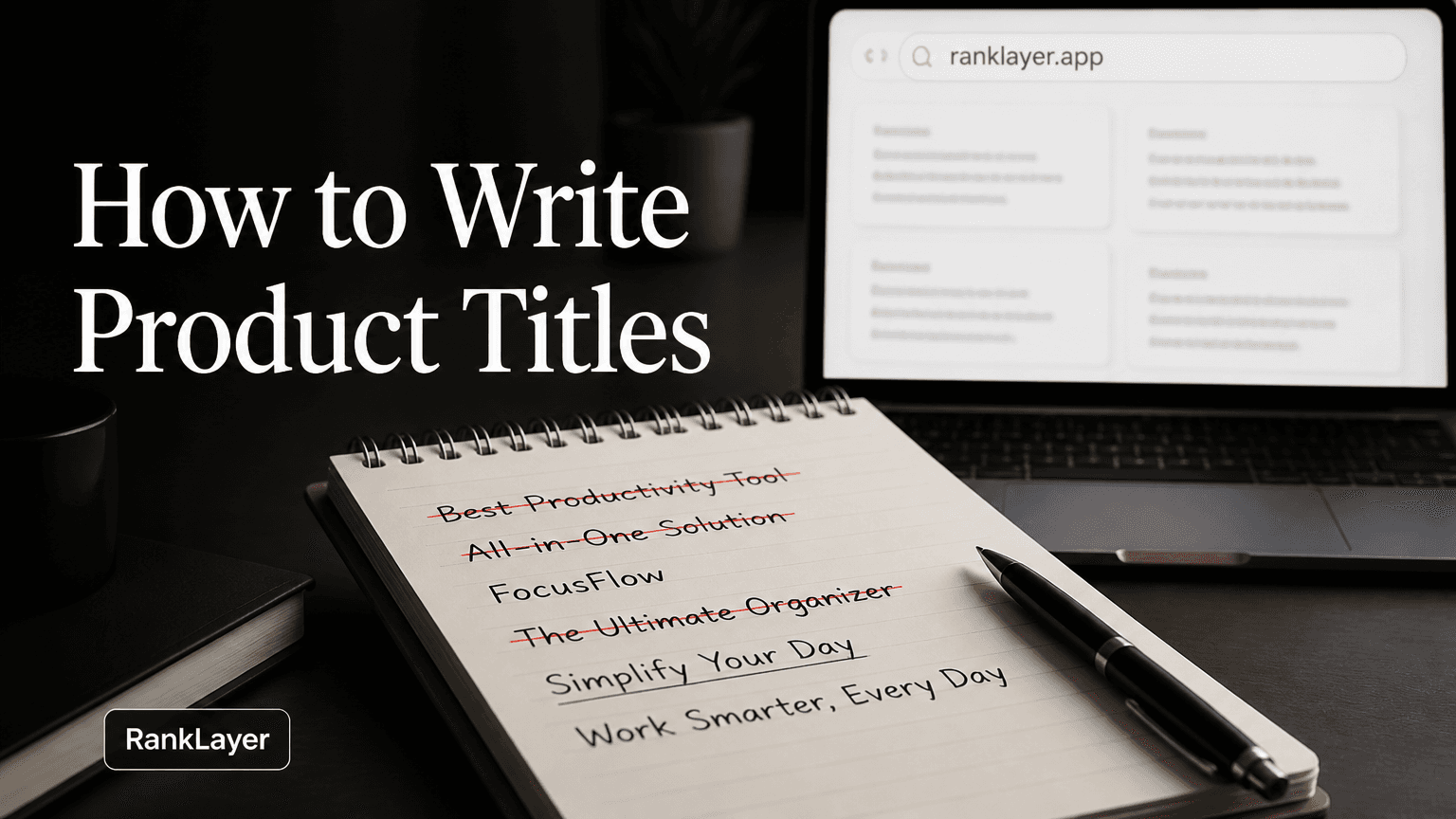
In this article9 sections
- Why product titles matter for AI citations and Google visibility
- The six-step product title formula for AI-citable pages
- How long should a product title be for Google and AI answer engines?
- Should you include SKUs, locations, and conversational phrases?
- Product title examples for retail, services, and SaaS
- How schema and microcopy support a strong product title
- How to operationalize product titles with an automatic blog
- Using RankLayer templates without editing code or WordPress
- A 10-minute product title audit and mistakes to avoid
Why product titles matter for AI citations and Google visibility
Product titles are no longer just labels on a shelf or short lines beneath an image. They help Google, ChatGPT, Gemini, and Perplexity understand what you sell, who it is for, where it applies, and which customer question it answers. That makes product titles a small piece of copy with an outsized job.
A vague title such as “Premium Starter Kit” leaves too much room for interpretation. A clearer version, “Beginner Indoor Herb Garden Kit with LED Grow Light,” identifies the product, its use case, and an important feature in one glance.
AI answer engines do not quote pages because a title contains magic words. They combine many signals, including page content, authority, freshness, accessibility, structured data, and how closely a page matches the user’s question. Still, a precise title gives the system a useful first clue and makes the rest of the page easier to classify.
Think of the title as the label on a file folder. If the folder says “Important Stuff,” nobody knows what is inside. If it says “2026 Tax Checklist for Freelancers in Austin,” the purpose is obvious before anyone opens it.
Google recommends writing descriptive, concise page titles that accurately describe the page. Its official title link guidance is useful because the same principles apply to product pages: accuracy beats hype, and clarity beats cleverness.
For small businesses, this matters even more. You may not have thousands of backlinks or a large content team, but you can describe your products in the language customers actually use. That clarity gives search systems a better chance of connecting your page with specific questions such as “What is the best lightweight stroller for air travel?” or “Where can I buy a vegan birthday cake near me?”
The six-step product title formula for AI-citable pages
- 1
Name the product category first
Start with the thing the buyer is looking for, not your internal product name. Use terms such as running shoes, tax preparation service, appointment software, or protein powder before adding brand language.
- 2
Add the primary use case
Explain what the product helps someone do. “Project management software for remote teams” is more useful than “FlowPro Professional,” especially for a buyer who has never heard of your brand.
- 3
Include one or two decision-making attributes
Choose attributes that change the buying decision, such as size, material, audience, compatibility, dietary requirement, location, or pricing model. Avoid stuffing every specification into the title.
- 4
Add a location only when it changes relevance
Use a city, neighborhood, or service area when customers genuinely search by place. “Emergency dental clinic in Tampa” is helpful, while adding a city to a nationally shipped phone case may create unnecessary repetition.
- 5
Use natural customer language
Read reviews, support tickets, sales chats, and Google Search Console queries to find the phrases customers use. A title that sounds like a real question or recommendation is often easier for an answer engine to connect with a conversational prompt.
- 6
Keep the promise consistent across the page
The introduction, product facts, FAQs, offers, and structured data should support the title. If the title says “same-day flower delivery in Denver,” the page should clearly explain delivery areas, cutoff times, and availability.
How long should a product title be for Google and AI answer engines?
There is no universal character limit that guarantees a citation. Google may truncate a title link based on available screen width, while an AI system may process the complete page and use the title as one part of a broader retrieval decision.
For most product pages, aim for roughly 45 to 65 characters when possible. That range is not a rule. It is a practical editing target that usually leaves room for the product category, use case, and a meaningful differentiator.
Tokens are different from characters. Language models break text into pieces called tokens, and the number varies by word, language, punctuation, and model. You do not need to count tokens manually. Clear words with specific meaning are more valuable than squeezing in extra keyword variations.
Compare these examples:
“EcoFlex Pro” is short, but it tells a new customer almost nothing.
“EcoFlex Pro Reusable Water Bottle, 32 oz, Leakproof” is longer, but it communicates category, brand, capacity, and a useful feature.
“Best Premium EcoFlex Pro Water Bottle for Everyone Who Wants the Ultimate Leakproof Hydration Experience” is overloaded. It sounds promotional, repeats ideas, and hides the actual product details.
A good title usually has one main subject and one clear angle. If you need five attributes to explain the product, move the extras into bullet points, product specifications, headings, and FAQ content.
Your title should also match the visible heading when practical. They do not need to be identical, but a large mismatch can create confusion. Someone who clicks “Affordable bookkeeping for small businesses in Phoenix” should not land on a page headed only “Accounting Solutions.”
Should you include SKUs, locations, and conversational phrases?
- ✓Use a SKU when buyers search for it, compare exact variants, request support by item number, or need to distinguish nearly identical products. For example, “Canon EOS R50 Camera Body, SKU 5811C002” can help a specialist retailer, but a long SKU may be noise in a consumer-facing title.
- ✓Use geolocation when the product or service is genuinely location-dependent. Local service businesses should prioritize the service and location, such as “Emergency Plumber in Raleigh,” while online stores should avoid creating dozens of thin titles that differ only by city.
- ✓Use common speech when customers actually use it. “Laptop repair near me,” “birthday cake delivery,” and “software for small law firms” reflect real intent better than internal language such as “device remediation,” “celebration confectionery,” or “vertical legal workflow platform.”
- ✓Include a product model, size, compatibility, or material when it helps buyers distinguish options. These details are especially useful for e-commerce products with variants, accessories, replacement parts, or technical requirements.
- ✓Do not add claims you cannot prove. Words such as “best,” “cheapest,” “guaranteed,” and “number one” can create trust and compliance problems when the page offers no evidence. Specific facts are safer and more useful.
- ✓Treat title variants as a system, not a copying exercise. If you sell the same item in multiple colors or sizes, make each page meaningfully useful or consolidate variants instead of producing near-identical titles and pages.
Product title examples for retail, services, and SaaS
The fastest way to improve titles is to compare an internal label with the phrase a customer would use. The examples below show how a small change can add category, intent, and context without turning the title into a paragraph.
For retail, change “CloudSoft” to “CloudSoft Women’s Cotton Pajamas, Lightweight Summer Set.” The improved version identifies the brand, audience, material, product type, and seasonal use case. It gives a shopper and an answer engine several useful connections without making unsupported claims.
For a local service, change “Complete Care” to “Walk-In Family Dentist in Columbus, Ohio.” The second title makes the service, audience, location, and access model clear. If the clinic only accepts appointments, replace “Walk-In” with an accurate phrase such as “Same-Week Appointments.”
For a SaaS product, change “Growth Suite” to “Simple CRM for Freelancers and Small Agencies.” This version explains what the software is and who it serves. It can support related searches about managing leads, tracking proposals, and organizing client follow-up.
For an online course, change “Level Up” to “Beginner Excel Course for Small Business Owners.” The revised title avoids vague motivation language and describes the learner, skill, and level. You can use the page body to explain lessons, format, instructor experience, and expected outcomes.
For a product comparison page, use a question-led title such as “Best Inventory Software for Shopify Stores Under 1,000 Orders.” It is more useful than “Inventory Tools Compared” because it defines the audience and buying constraint. Make sure the page then explains the comparison criteria rather than simply repeating the phrase.
If you need more headline and opening-copy ideas, this guide to headline and lead-sentence formulas for AI answer engines covers the relationship between the title, first paragraph, and quotable answer blocks.
How schema and microcopy support a strong product title
A title works best when it is part of a consistent information system. The visible title tells people what the page is about, the page copy explains the promise, structured data labels important facts, and microcopy answers small objections such as delivery time, compatibility, or who the product is for.
For a product page, Product structured data can describe details such as name, image, description, brand, SKU, offers, availability, and review information. Follow the Google Product structured data documentation and only mark up information that is visible and accurate on the page.
A simple conceptual Product schema pairing might look like this: {"@context":"https://schema.org","@type":"Product","name":"CloudSoft Women's Cotton Pajamas","brand":{"@type":"Brand","name":"CloudSoft"},"category":"Women's sleepwear","description":"Lightweight cotton pajama set for warm-weather nights","sku":"CS-PJ-32"}. The schema does not replace good copy, and it does not guarantee an AI citation, but it reduces ambiguity for machines that parse the page.
Now pair the title with short, factual microcopy. Under “CloudSoft Women’s Cotton Pajamas, Lightweight Summer Set,” add “100% cotton, sizes XS to XXL, ships in one business day.” Each statement supports a likely follow-up question and gives a reader a reason to continue.
For a local service, the pairing could be “Walk-In Family Dentist in Columbus, Ohio” followed by “Accepting new patients Monday through Saturday. Call before visiting to confirm same-day availability.” This is more helpful than adding “trusted” or “best” without evidence.
For SaaS, use “Simple CRM for Freelancers and Small Agencies” followed by “Track leads, proposals, and follow-ups in one workspace. Plans start at $19 per month.” Pricing and feature claims must stay synchronized with the current offer.
Schema.org provides the vocabulary, but search platforms decide how and whether to use the information. The Schema.org Product vocabulary is a useful reference for choosing fields without inventing custom properties. Keep the implementation boring and accurate. Boring data is wonderfully easy to trust.
How to operationalize product titles with an automatic blog
- 1
Build a title input sheet
Create columns for product category, brand, use case, audience, location, key attribute, SKU, availability, and customer phrase. This turns title writing into a repeatable process instead of a memory test performed at midnight.
- 2
Collect real language from customers
Review Google Search Console, Google Analytics, customer emails, reviews, chat transcripts, and sales calls. RankLayer can use structured business inputs to generate and publish content, but your real customer language remains the best source for useful distinctions.
- 3
Generate a title and opening answer together
Do not optimize the title in isolation. Create a short first paragraph that directly answers the likely question, then support it with facts, specifications, FAQs, and a clear next step.
- 4
Add the supporting data automatically
Use a consistent template for Product, LocalBusiness, Service, or FAQ information where appropriate. Validate the result, check that the marked-up facts are visible, and remove fields that do not apply.
- 5
Review the risky pages first
Manually review regulated services, medical claims, legal topics, pricing pages, and products with many variants. Automation is excellent for consistency and scale, while human review is still valuable when an inaccurate sentence could create real harm.
- 6
Measure discovery and business outcomes
Track impressions, clicks, conversions, assisted leads, and customer questions. AI citation visibility is useful, but the title is doing its job only when it helps the right people understand and choose your offer.
Using RankLayer templates without editing code or WordPress
Once the copy principles are clear, a hosted system can make them easier to apply consistently. RankLayer is designed for businesses that want an automatic AI blog with hosting included, so owners can publish useful, search-focused pages without setting up WordPress or managing a technical stack.
A practical RankLayer template can generate a title from controlled fields such as product type, audience, location, differentiator, and customer question. It can then pair that title with a concise answer, supporting sections, internal links, and structured content modules instead of producing a title that floats above unrelated copy.
For example, a small skincare store could use the pattern “Mineral Sunscreen for Sensitive Skin, SPF 30, Fragrance-Free.” The supporting page should explain ingredients, use, skin type, size, shipping, and product limitations. A salon could use “Curly Haircut in Austin for First-Time Clients,” followed by preparation instructions, pricing context, and a booking option.
This approach is useful when you need many pages in a consistent format, but consistency should never mean sameness. Vary the customer question, evidence, examples, and product facts so each page earns its place. A hundred pages with one useful sentence each will not outperform ten pages that genuinely solve distinct problems.
Before publishing, check five things: the title matches the page, the main phrase sounds natural, the product facts are current, the location is accurate, and the first answer is understandable without marketing jargon. Those checks take minutes and prevent the kind of mismatch that makes both humans and machines lose confidence.
For a broader setup checklist, see this guide to choosing an automatic AI blog for lead generation and AI citations. If you are starting without a website, the zero-setup AI blog launch checklist explains the practical publishing foundations separately from title writing.
A 10-minute product title audit and mistakes to avoid
- ✓Read the title aloud. If it sounds like a spreadsheet export, rewrite it in the language a customer would use when asking for help.
- ✓Put the product category near the beginning. Brand names matter, but unfamiliar brands should not force readers to guess what you sell.
- ✓Remove empty adjectives. Premium, innovative, powerful, and complete are not useful unless the page explains what they mean.
- ✓Check the first 100 words of the page. They should confirm the title and answer the most obvious buyer question without making the reader hunt.
- ✓Verify every time-sensitive detail. Inventory, price, delivery promises, opening hours, and service areas can become wrong quickly.
- ✓Use SKUs selectively. Keep them when they support exact-product discovery, technical support, or variant selection, but do not let an internal code dominate a consumer title.
- ✓Avoid location stuffing. One accurate location can improve relevance, while a chain of cities can make the page look artificial and reduce trust.
- ✓Do not promise citations. No title formula can force ChatGPT, Gemini, or Perplexity to quote a page. Your goal is to make the page clear, relevant, accessible, and genuinely useful.
- ✓Compare the title with the URL, H1, meta title, image alt text, and Product schema. Minor differences are fine, but major contradictions are a warning sign.
- ✓Review performance after publishing. Look for impressions and queries in Search Console, then update titles when customers reveal a better way to describe the product.
Frequently Asked Questions
What makes a product title more likely to be quoted by ChatGPT, Gemini, or Perplexity?▼
A useful product title clearly identifies what the product is, who it serves, and what makes it relevant to the user’s question. It should match the visible page content and be supported by specific facts, helpful microcopy, and accurate structured data. AI answer engines do not select sources from titles alone, so relevance, trust, accessibility, and page quality still matter.
How many characters should a product title have for SEO?▼
A practical target is roughly 45 to 65 characters, but there is no guaranteed character limit for Google or AI answer engines. Write the clearest title first, then remove unnecessary words and repeated modifiers. If an important product attribute does not fit, place it in the H1, opening paragraph, specification list, or FAQ instead of creating an unreadable title.
Should I include a SKU in my product title?▼
Include a SKU when shoppers, distributors, or support teams search for the exact code or when it distinguishes very similar variants. For ordinary consumer products, the SKU may be more useful in structured data, specifications, and the page body than in the main title. Test both approaches using Search Console queries and customer feedback rather than assuming every code improves visibility.
Should local businesses add a city or neighborhood to product titles?▼
Add a location when the product or service is genuinely tied to that place, such as a dentist, florist, repair shop, or local delivery service. Use one accurate location and explain the service area on the page. National e-commerce stores should avoid creating thin city variations unless customers truly receive different inventory, delivery, pricing, or service by location.
Do product titles need to match the H1 and meta title exactly?▼
They do not need to be identical, but they should communicate the same subject and promise. A product title can be concise, while the H1 adds context and the meta title is edited for search-result display. Large differences, such as a title about one product and an H1 about a broad category, can confuse users and search systems.
Can structured data make ChatGPT, Gemini, or Perplexity quote my product page?▼
Structured data can make important facts easier for search systems to interpret, but it cannot guarantee a citation. Use Product, Organization, LocalBusiness, Service, or FAQ vocabulary only when it accurately describes visible content. The strongest approach combines accurate schema with clear titles, useful answers, trustworthy business information, and pages that solve a specific customer need.
What is the best product title formula for a SaaS product?▼
Start with the software category, add the primary audience or use case, and include one meaningful differentiator. For example, “Simple CRM for Freelancers and Small Agencies” is clearer than a brand-only title such as “FlowPilot.” Support the title with feature details, pricing context, integrations, limitations, and answers to the questions buyers ask before signing up.
Turn clearer titles into a repeatable content system
Explore RankLayerAbout the Author
Vitor Darela de Oliveira is a software engineer and entrepreneur from Brazil with a strong background in system integration, middleware, and API management. With experience at companies like Farfetch, Xpand IT, WSO2, and Doctoralia (DocPlanner Group), he has worked across the full stack of enterprise software - from identity management and SOA architecture to engineering leadership. Vitor is the creator of RankLayer, a programmatic SEO platform that helps SaaS companies and micro-SaaS founders get discovered on Google and AI search engines