AI Freshness Signals: A Non-Developer’s Guide to Headers, Sitemaps, and Caching
Understand the technical signals that help Google and AI answer engines discover updated business content, without becoming a developer.
Explore the no-code publishing approach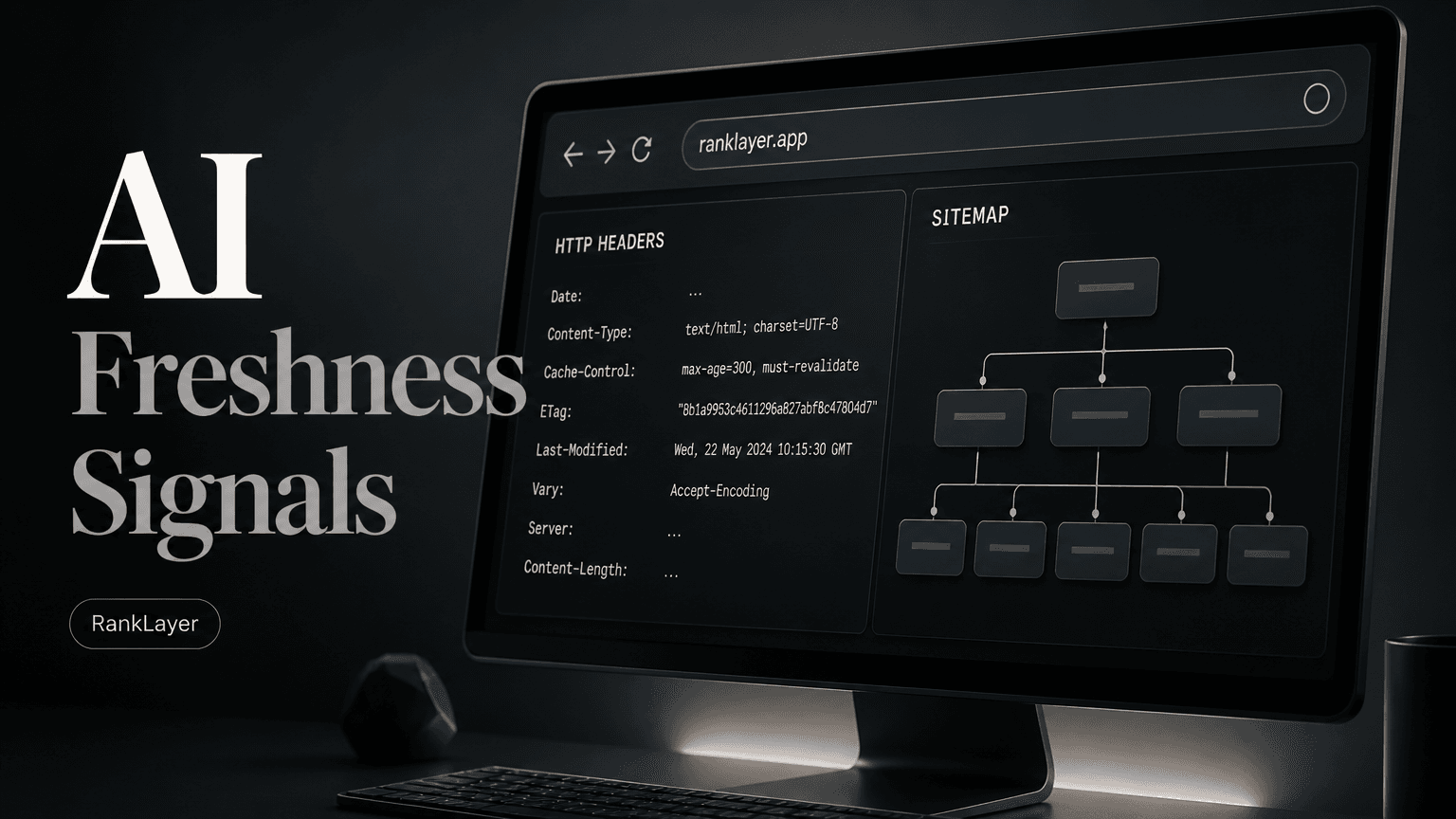
In this article7 sections
- What are AI freshness signals, and why do they matter?
- Which HTTP headers support content freshness?
- How should you use sitemaps as freshness signals?
- A 10-minute freshness checklist for a hosted blog
- Freshness mistakes that quietly reduce visibility
- How RankLayer handles freshness without developer work
- How to measure whether freshness work is helping
What are AI freshness signals, and why do they matter?
AI freshness signals are the technical and content clues that indicate when a page was published, changed, or made available to crawlers. They include visible dates, the last modification date in a sitemap, HTTP response headers such as Last-Modified and ETag, reliable internal links, and a page that returns a fast, consistent response. These signals do not guarantee that ChatGPT, Gemini, or Perplexity will cite you, but they make it easier for search systems and retrieval tools to discover the right version of your content. Imagine a restaurant that changes its lunch menu every Monday but leaves last month’s menu on the front door. Even if the restaurant is excellent, visitors receive outdated information. A web crawler faces the same problem when a page looks old, a sitemap is stale, or a cache keeps serving yesterday’s version. Freshness is not about changing a comma every morning. It is about making meaningful updates visible and dependable. AI answer engines typically need several things before they can use a business page: access, discovery, understandable content, and enough confidence that the information is relevant. Google explains that its systems use many signals to crawl, index, and serve pages, while no single technical setting guarantees inclusion. You can review the basics in Google’s documentation on how search works. For example, a dental clinic publishes a page answering “Do I need a mouthguard for nighttime teeth grinding?” If the answer is clear, medically responsible, linked from the clinic’s blog, and updated when its service details change, it has a stronger foundation than an isolated page with no date or discovery path. The technical layer supports the content. It does not replace useful expertise, accurate claims, or a reason for someone to trust the business.
Which HTTP headers support content freshness?
HTTP headers are short instructions sent by a web server before the page body. You usually do not see them while browsing, but crawlers, browsers, and content delivery networks can use them to decide whether to reuse a stored response or request the page again. The three headers most relevant to freshness are Cache-Control, ETag, and Last-Modified. Cache-Control controls how a response may be stored and reused. For a frequently updated article, a cautious pattern is Cache-Control: public, max-age=0, must-revalidate. In plain English, the page may be stored, but the next request should check whether the server has a newer version. For a genuinely stable asset, such as a logo or stylesheet, a longer cache period can improve speed. Do not apply a year-long cache to an article that changes every day unless your publishing system also creates reliable versioned URLs. ETag is a version identifier. A server might return ETag: "article-482-v7". When a crawler comes back, it can send If-None-Match: "article-482-v7". If nothing changed, the server can respond with 304 Not Modified, saving bandwidth. If the article changed, the server returns the new content and a new tag. ETags are useful for efficient rechecking, but they are not a magic “cite this page” button. Last-Modified tells clients when the server believes the resource last changed. A typical response looks like Last-Modified: Mon, 17 Aug 2026 09:30:00 GMT. The date should reflect a real content or material metadata update, not an automated timestamp that changes every time the page is requested. False freshness can waste crawl resources and make your site’s update history less credible. The practical lesson is simple: headers help systems check your pages efficiently, while content and crawlability determine whether those pages are worth using. The HTTP caching guidance from MDN explains the browser and intermediary behavior behind these directives. If you do not control your server, do not paste header rules into random plugins. Ask your hosting provider whether it sends sensible cache validation and modification headers for HTML pages.
How should you use sitemaps as freshness signals?
A sitemap is a discovery file that lists important URLs and, optionally, when each URL was last modified. For an automatic blog, it acts like a clean delivery schedule for search crawlers. When a new article goes live, the sitemap should include it. When an existing article receives a substantial update, its last modification value should change. When a page is removed permanently, the sitemap should stop presenting it as an active URL. The key field is <lastmod>. Use the date or timestamp for the actual meaningful update, such as a revised price, new service area, corrected product specification, or expanded answer. Do not update every URL each day just because your publishing system ran. Google’s sitemap documentation specifically emphasizes accurate last modification dates and warns against using change frequency as a guarantee of crawling. The older <changefreq> and <priority> fields are often misunderstood. They can appear in the Sitemap Protocol, but major search engines do not treat them as promises that a page will be crawled at a particular interval or ranked higher. A daily blog does not need changefreq set to daily to earn attention. Accurate URLs, internal links, useful content, proper canonical signals, and a healthy server matter more. A sensible small-business setup might contain a sitemap index with separate files for posts, landing pages, and products once the site becomes large. A small blog may need only one sitemap. Either way, submit the sitemap in Google Search Console and check that the reported URLs are indexable. Search Console helps you identify whether Google can read the file, but it does not force indexing. For broader AI visibility, the same public pages still need to be accessible to the relevant retrieval systems and valuable enough to be selected. Keep your sitemap boring. Boring is good here. Avoid session IDs, tracking parameters, blocked URLs, redirected URLs, duplicate versions, and pages marked noindex. If a product page says a color is available today, but the sitemap and page remain unchanged after the inventory is gone, the technical signal is not the real problem. The business information itself needs a dependable update workflow. For topic planning before publication, the 90-day programmatic content planner for small businesses without a website can help you separate evergreen subjects from time-sensitive ones.
A 10-minute freshness checklist for a hosted blog
- 1
Open a published article in a private browser window
Confirm that the page loads without a login, pop-up wall, or JavaScript-only content. AI systems cannot reliably use information they cannot access. Test both the canonical URL and the URL shown in your sitemap.
- 2
Check the visible date and update language
Look for a clear published date and, when appropriate, an updated date. Use wording such as “Updated August 17, 2026” only when the article received a meaningful revision. Make sure the date is consistent with the sitemap lastmod value.
- 3
Inspect the page response headers
Use a browser extension, an online header checker, or the network panel in your browser. Look for a 200 status, Last-Modified, ETag, and a reasonable Cache-Control policy. You do not need to edit these values yourself if your host manages them.
- 4
Open the XML sitemap
Visit
/sitemap.xmlor the sitemap address provided by your platform. Find the article URL and verify that it appears once, uses HTTPS, and has a realistic lastmod value. A new post that is missing from the sitemap has a discovery problem. - 5
Confirm internal discovery
Make sure the article is linked from a category, a related article, or a site navigation area. A sitemap is helpful, but links provide context and paths for crawlers and readers. Avoid publishing hundreds of pages that are technically listed but practically orphaned.
- 6
Submit or verify the property in Search Console
Use URL Inspection for a small number of priority pages and monitor the sitemap report for the site as a whole. Do not repeatedly request indexing for every daily post. Fix access, quality, canonical, or rendering issues instead.
Freshness mistakes that quietly reduce visibility
- ✓Changing Last-Modified on every request: This creates artificial freshness and may trigger unnecessary rechecks. Update it when the page content or an important business fact actually changes.
- ✓Caching HTML for too long: A seven-day or one-year HTML cache can leave crawlers and visitors with an outdated version. Long caching is better suited to versioned static assets than fast-changing articles.
- ✓Assuming changefreq means guaranteed crawling: A sitemap value is a hint, not a booking reservation with Googlebot. Accurate lastmod and strong page quality are more useful than declaring that every page changes daily.
- ✓Publishing first and fixing discovery later: A page should be linked, included in the sitemap, canonicalized, and publicly accessible at launch. The first few hours after publication are not a reason to panic, but a repeatable launch process prevents silent failures.
- ✓Refreshing without improving: Replacing dates while leaving obsolete advice untouched does not create real freshness. Add current examples, correct facts, clarify the answer, and remove claims that no longer apply.
- ✓Blocking the wrong crawlers: Robots rules, firewall settings, and bot protection can prevent legitimate discovery. Review the robots.txt and meta robots checklist for AI crawlers before assuming the content itself is invisible.
- ✓Creating a sitemap full of weak URLs: More URLs do not automatically mean more authority. Keep thin, duplicate, expired, or low-value pages out of the indexable publishing workflow, and review automated output regularly.
- ✓Expecting technical signals to overcome weak content: Headers and sitemaps can help a good page get rechecked. They cannot make an inaccurate, generic, or unsupported article worthy of citation.
How RankLayer handles freshness without developer work
A hosted automatic blog is useful here because the technical layer does not have to become another job on your calendar. RankLayer creates and publishes articles automatically, with hosting included, so a business owner can focus on choosing useful topics and reviewing important claims instead of configuring a server, XML generator, caching layer, and deployment pipeline separately. For a RankLayer-hosted blog or subdomain, the practical workflow is straightforward: a new article is published at a public URL, the sitemap is updated as part of the publishing process, and the page carries its publication or modification information. RankLayer also connects with Google Search Console, which gives you a way to monitor sitemap processing and indexing signals after publication. That combination supports discovery, but it should still be paired with strong internal linking and useful, specific answers. If you are evaluating a hosted platform, ask to see the actual response rather than accepting a vague promise that it is “AI optimized.” Request a live example and check four things: the status code is 200, the canonical points to the intended URL, the sitemap contains the page, and the HTML contains readable content without requiring a browser interaction. You can also ask how the platform handles a revised article, an unpublished page, and a temporary outage. For example, suppose an online store publishes an article about choosing a backpack for airline travel. The original page goes live on August 10. On August 17, the store updates carry-on size guidance and adds a product example. The correct workflow changes the page’s meaningful modification date, updates the sitemap entry, serves the revised HTML after cache validation, and leaves the URL stable. That is much cleaner than creating a new URL every time the advice changes. RankLayer is not a guarantee of a ChatGPT, Gemini, Perplexity, or Claude citation. No platform can honestly promise that, because answer engines choose sources dynamically. The no-code advantage is operational: consistent publishing, included hosting, sitemap maintenance, and Search Console integration reduce the technical mistakes that can keep genuinely useful business content difficult to discover. To understand the broader signals beyond freshness, compare this workflow with the AI citation signals checklist for small businesses.
How to measure whether freshness work is helping
Start with crawl and indexing evidence before looking for an AI citation. In Google Search Console, monitor sitemap URLs, indexed pages, impressions, clicks, and the date when important pages begin receiving impressions. A new page may need time to be discovered and evaluated, so judge patterns across a group of similar pages rather than one article published yesterday. For a simple 30-day test, choose ten pages with clear business intent. Record each URL’s publication date, sitemap lastmod date, impressions, clicks, and conversions. Update five pages with genuinely better information and leave five comparable pages unchanged. Keep the topics and promotion level reasonably similar. This is not a laboratory experiment, but it can show whether your update process is producing measurable movement instead of merely changing timestamps. AI citation measurement is less standardized. Run a small set of realistic prompts in ChatGPT, Gemini, and Perplexity, using neutral wording such as “What are good options for [service] in [location]?” Record whether your business appears, which URL is cited, and whether the cited page contains the answer the user needed. Repeat the test monthly, because results can vary by model, location, account, browsing mode, and query wording. The guide to tracking AI citations and attributing organic leads offers a useful measurement framework for connecting visibility with business outcomes. Prioritize freshness where facts expire quickly: prices, inventory, opening hours, appointment availability, regulations, product specifications, seasonal services, and software features. Evergreen explanations may need an annual review, while a flash sale page may need an end date and a clear archival plan. Freshness is a resource allocation decision, not a race to publish the most timestamps. The best technical setup is the one you can operate consistently. A small business with ten accurate, discoverable pages can build more trust than one with 1,000 neglected URLs. If your content is published daily, schedule a monthly quality review and a quarterly technical spot check. That rhythm keeps automation helpful rather than turning it into a content confetti cannon.
Frequently Asked Questions
Do HTTP headers directly make ChatGPT cite my business?▼
No. HTTP headers do not directly instruct ChatGPT, Gemini, or Perplexity to cite a page. Cache-Control, ETag, and Last-Modified help crawlers and intermediaries request and validate content efficiently, which can support reliable discovery. Citation decisions also depend on access, relevance, content quality, authority, query intent, and the answer engine’s own retrieval process. Treat headers as infrastructure that removes friction, not as a ranking or citation shortcut.
What does Last-Modified mean for SEO and AI search?▼
Last-Modified tells a client or crawler when the server believes a page last changed. It can help a crawler decide whether to revalidate a stored response, especially when the page is checked repeatedly. The value should represent a meaningful update, such as corrected facts, revised pricing, or expanded guidance. Changing it automatically without changing the page does not create useful freshness and may waste crawl activity.
How often should an automatic blog update its sitemap?▼
The sitemap should reflect publishing and meaningful content changes as they happen, rather than being updated on an arbitrary daily schedule. A new article should be added promptly, and a revised article should receive an accurate lastmod value. The sitemap itself does not need to be manually recreated every day if your platform generates it automatically. Changefreq and priority are not guarantees of crawling, so focus on accurate URLs, accessible pages, internal links, and useful content.
Should I set changefreq to daily for a daily AI blog?▼
You can include changefreq where your sitemap format supports it, but setting it to daily does not force Google or another system to crawl the page every day. It is better to publish at a cadence you can support with accurate, useful content. Use lastmod to report real changes, and avoid making every page appear freshly edited after an automated batch runs. A daily publishing schedule should create new value, not just new timestamps.
What is the best Cache-Control header for frequently updated blog posts?▼
There is no universal best value because the right policy depends on your hosting architecture, CDN, and publishing workflow. A cautious example for frequently updated HTML is Cache-Control: public, max-age=0, must-revalidate, which allows storage while requiring validation before reuse. Some platforms may use a short shared cache period and purge it automatically when a page changes. If you do not manage the server, ask your host how quickly a published revision becomes visible and whether ETag or Last-Modified validation is enabled.
Can a non-technical business owner check freshness signals without a developer?▼
Yes. You can open the public page, inspect the sitemap, use Google Search Console, and view response headers with a browser tool or header checker. You do not need to edit server configuration to identify common problems such as a missing sitemap entry, a blocked page, a redirect, or an unusually long HTML cache. If a header looks wrong, send the URL and the observed response to your hosting provider instead of changing code blindly. Hosted platforms can handle the infrastructure while you manage topics, accuracy, and business priorities.
Does updating a page date improve its chances of appearing in AI answers?▼
A date alone is weak evidence. A meaningful update can make a page more useful for time-sensitive questions, and accurate metadata helps systems understand what changed. However, an answer engine still needs to find the page, understand its claims, and decide that it is a good source for the user’s question. Update the substance first, then update the visible date and technical metadata so they agree.
How does RankLayer update sitemaps and freshness metadata?▼
RankLayer’s hosted automatic blog workflow publishes articles at public URLs and manages the supporting blog infrastructure, including sitemap updates and publication or modification information. Its Google Search Console integration helps business owners monitor how the hosted content is being processed. The exact response headers can depend on the hosting layer, so a practical evaluation is to inspect a live page and ask how cache validation works after an edit. These features improve operational consistency, but they do not guarantee citations from any AI answer engine.
Want the technical foundation handled for you?
Explore RankLayer’s no-code blogAbout the Author
Vitor Darela de Oliveira is a software engineer and entrepreneur from Brazil with a strong background in system integration, middleware, and API management. With experience at companies like Farfetch, Xpand IT, WSO2, and Doctoralia (DocPlanner Group), he has worked across the full stack of enterprise software - from identity management and SOA architecture to engineering leadership. Vitor is the creator of RankLayer, a programmatic SEO platform that helps SaaS companies and micro-SaaS founders get discovered on Google and AI search engines